
Testimonials
शास्त्र–सिद्धान्त–प्रयोग समन्वितम्
Śāstra–Siddhānta–Prayoga Samānvitam
“Where scriptural knowledge, established principles, and practical execution are harmoniously integrated.”
Acknowledged by Scholars & Indologists
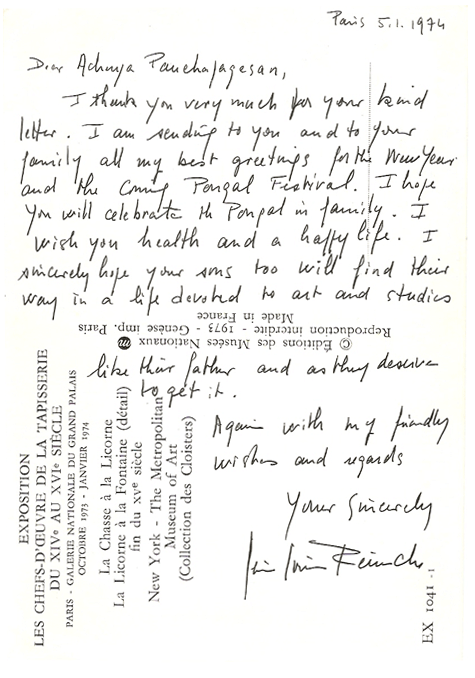
Mary Louis Réinch, renowned French Indologist and author of the Tiruvannamalai series (Vol. 5), personally wrote to our family in 1974, appreciating our dedication to traditional temple architecture and Vedic arts. She recognized the scholarly devotion of our lineage in preserving sacred knowledge.
Here in one of her letters to my father :
Dear Acharya Panchapagesan,
I sincerely hope your sons too will find their way in a life devoted to art and studies like their father and as they deserve to get it.
Mary Louis Reinch.
(The signature is reproduced as written in the original letter.)
Mary Louis Reinch
French Indologist
Paris 5.1.1974
Marie-Louise Reiniche
Marie-Louise Reiniche (1934 – 2008) was a French anthropologist and indologist known for her pioneering fieldwork on South Indian religious practices. A specialist in Hinduism and ritual, she helped shape post-war French anthropology of India through her teaching and research at leading academic institutions.
Affiliations: École pratique des hautes études (EPHE); École française d’Extrême-Orient (EFEO); École des hautes études en sciences sociales (EHESS); Major work: Les Dieux et les hommes (1979)
Academic career
Reiniche trained in ethnology under Madeleine Biardeau and became Director of Studies at EPHE (1989–2002) and at EFEO (1992–1993). She also served as maître de conférences at EHESS (1977–1989). Her research was anchored in the Centre d’études de l’Inde et de l’Asie du Sud (CNRS-EHESS), where she mentored numerous doctoral students in anthropology and religious studies.
Research and publications
Reiniche’s scholarship focused on Hindu ritual practice, temple organization, and sociopolitical aspects of religion in Tamil Nadu. Her notable monographs include Les Dieux et les hommes: étude des cultes d’un village du Tirunelveli, Inde du Sud (1979) and the multi-volume Tiruvannamalai: un lieu saint śivaïte du sud de l’Inde (École française d’Extrême-Orient, 1989–1990). She also co-edited works such as Les ruses du salut (1995) and Les apparences du monde (2006), exploring the intersection of religion and politics in South Asia.
Teaching and influence
Through her positions at French research institutions in Paris Reiniche helped establish a rigorous field-based anthropology of India within European academia. She supervised ground breaking thesis on topics such as caste, and gender in modern India, influencing a generation of scholars of South Asian religion and society.
Legacy
Her work remains a touchstone for studies of ritual material culture and the organization of sacred space in Hindu temples. By bridging philology and ethnography, Reiniche offered an enduring model for comparative analysis of religion and social structure in India.
Acharya N. Panchapagesan
This archive preserves selected correspondence between my father Acharya N. Panchapagesan and Marie-Louise Reiniche (1934–2008), The letters reflect a period of scholarly exchange during Reiniche’s field research in Tamil Nadu. They document a dialogue between traditional śāstric knowledge and academic anthropology, conducted in a spirit of mutual respect and intellectual seriousness.
The correspondence includes requests for guidance, discussions on temple structure and ritual practice, and expressions of learning and acknowledgment.
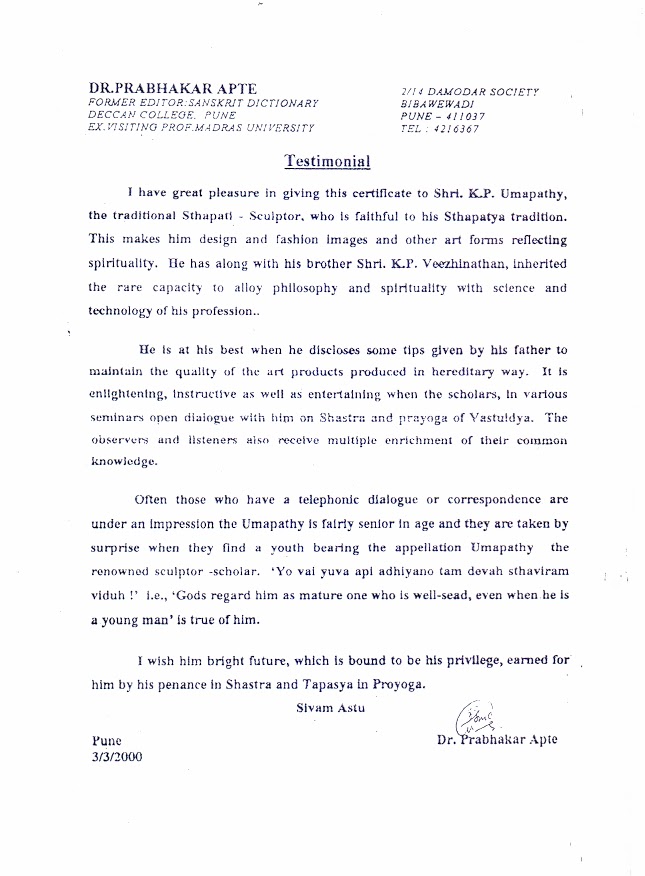
I have great pleasure in giving this certificate to Sri. K.P.Umapathy, the traditional Sthapati-sculptor, who is faithful to his Sthapatya tradition. This makes him design and fashion images and other art forms reflecting spirituality. He, along with his brother inherited the rare capacity to alloy philosophy and spirituality with science and technology of his profession.
‘Yo vai yuva api adhiyano tam devah sthaviram viduh’ i.e.‘ Gods regard him as a mature one who is well-stead, even when he is a young man’ is true to him. I wish him a bright future, which is bound to be his privilege, earned for him by his penance in Sastra and Tapasya in Prayoga.
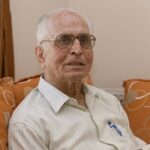 Dr. P. Prabhakara Apte
Visiting Prof. Rastriya Sanskrit University, Tirupati.
Ex. Editor, Sanskrit Dictionary Project, DC, Pune.
A Tribute from a Titan of Sanskrit Scholarship
Dr. Prabhakar Pandurang Apte (1932–2025)
Dr. Prabhakar Apte was a towering figure in the world of Indology, widely regarded as one of the most distinguished Sanskrit lexicographers and Agamic scholars of the modern era. Holding a Ph.D. in Sanskrit and a Master’s in Law (LL.M.), his career was defined by a rare ability to bridge the gap between ancient textual theory and practical application.
Distinguished Career & Qualifications:
- Editor, Sanskrit Dictionary Project: He served as a senior editor for the monumental Encyclopaedic Dictionary of Sanskrit on Historical Principles at Deccan College, Pune—the largest lexicographical project in the world.
- Academic Leadership: He was a Professor at the Academy of Sanskrit Research (Melkote) and an Adjunct Professor at Rashtriya Sanskrit Vidyapeetha (Tirupati).
- Renowned Author: Dr. Apte authored and edited numerous seminal works, most notably the critical edition and translation of the Samarangana Sutradhara of King Bhoja, and the three gems of the Pancaratra Agamas: the Paushkara Samhita, Sattvata Samhita, and Jayakhya Samhita.
The Three Gems of the Pancaratra Agamas (Ratnatraya)
In the vast ocean of Agamic literature, three texts stand as the supreme authorities—the Ratnatraya or “Three Jewels.” Dr. Prabhakar Apte’s life-long dedication to critically editing and translating these foundational scriptures has preserved the core of Indian ritual and architectural science.
- Sattvata Samhita: The “First Jewel,” focusing on the philosophical foundation of divinity and the manifestation of sacred energy.
- Paushkara Samhita: Regarded as the “Scientific Jewel,” it is the primary authority on Iconometry (Tala-mana), Mandalas, and the intricate technical rules of temple construction.
- Jayakhya Samhita: The “Spiritual Jewel,” detailing the esoteric rituals, mantras, and the internal yoga required of the practitioner.
Why this matters:
These texts are the “manuals of divinity” that dictate how a Sthapati must carve an image and build a temple. Dr. Apte’s mastery over these scriptures allowed him to recognize that Shri K.P. Umapathy Acharya was not just building structures, but was breathing life into these ancient Agamic laws through his practical work.
His Estimation of Shri K.P. Umapathy Acharya
In a historic testimonial dated March 3, 2000, Dr. Apte recognized K.P. Umapathy Acharya as a rare “Sculptor-Scholar.” Having spent his life among ancient manuscripts, Dr. Apte was profoundly moved to find a young master who not only possessed hereditary technical skill but also a deep mastery of the Silpa Shastras.
He famously applied the Manusmriti (2.156) verse to Umapathy Acharya:
“Gods regard him as mature one who is well-learned, even when he is a young man.”
Dr. Apte’s endorsement marked a pivotal moment in the tradition, certifying that Umapathy Acharya’s work was more than craftsmanship—it was “Tapasya in Prayoga” (meditation through practice). Their subsequent collaboration on the Samarangana Sutradhara stands as a testament to their shared vision of reviving the scientific and spiritual glory of Indian architecture.
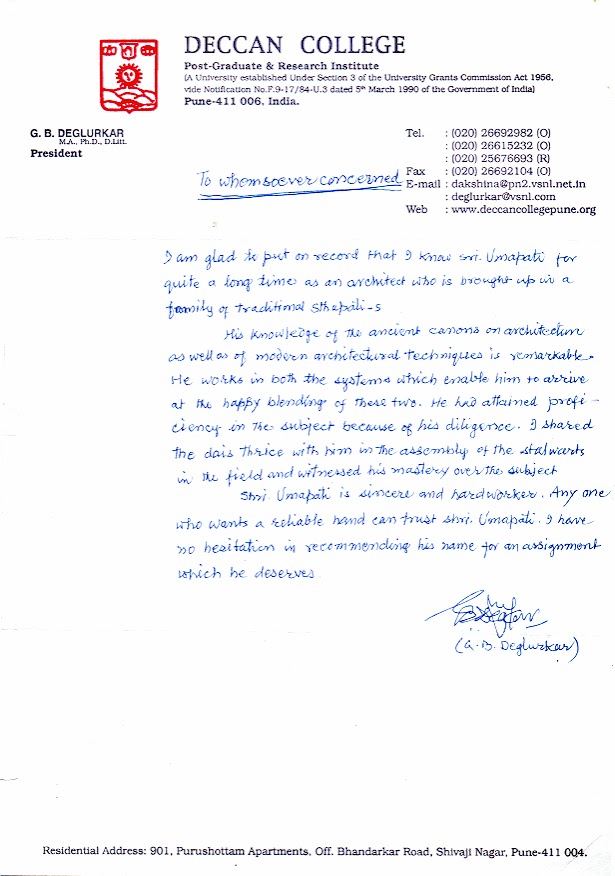
Sri Umapathy stands out as an architect deeply rooted in a lineage of traditional Sthapatis.
His mastery of ancient architectural canons and modern techniques creates a perfect harmony between tradition and innovation.
Having shared platforms with him, I have witnessed his scholarship, sincerity, and diligence firsthand.
A trustworthy professional, he truly deserves every recognition in his field.”
 Dr. G. B. Deglurkar
President,
Deccan College University,
Post-Graduate & Research Institute
Pune, India
Dr. G. B. Deglurkar (M.A., Ph.D., D.Litt.)
President, Deccan College Post-Graduate & Research Institute, Pune
Dr. G. B. Deglurkar is a legendary figure in Indian Art History and one of the world’s most respected authorities on Temple Architecture (Vastuvidya) and Iconography (Murti-shastra). As the head of Deccan College—one of India’s premier archaeological research institutes—his expertise has shaped the modern understanding of ancient Indian monuments.
A Distinguished Legacy
- The Authority on Iconography: Author of seminal works such as “Temple Architecture and Sculpture of Maharashtra” and “Portrayal of the Divine.”
- Scholarly Leadership: A D.Litt. scholar who has spent decades presiding over the most critical research in Indian archaeology and cultural heritage.
Critical Appraisal of Shri K. P. Umapathy Acharya
“I have shared the dais thrice with him in the assembly of the stalwarts in the field and witnessed his mastery over the subject.”
— Dr. G. B. Deglurkar
Dr. Deglurkar’s endorsement identifies the core strengths that define Shri K. P. Umapathy’s career:
- The “Happy Blending”: He recognizes Umapathy Acharya as a rare practitioner who has achieved a perfect harmony between Ancient Shastric Canons and Modern Architectural Techniques.
- Peer Recognition: By noting their shared stage in assemblies of “stalwarts,” Dr. Deglurkar validates Shri Umapathy not just as a master craftsman, but as an intellectual peer to the world’s leading historians and archaeologists.
- Hereditary Diligence: He emphasizes that this proficiency is the result of both a traditional lineage and profound personal diligence, marking him as a “reliable hand” for the most sacred and complex architectural assignments.
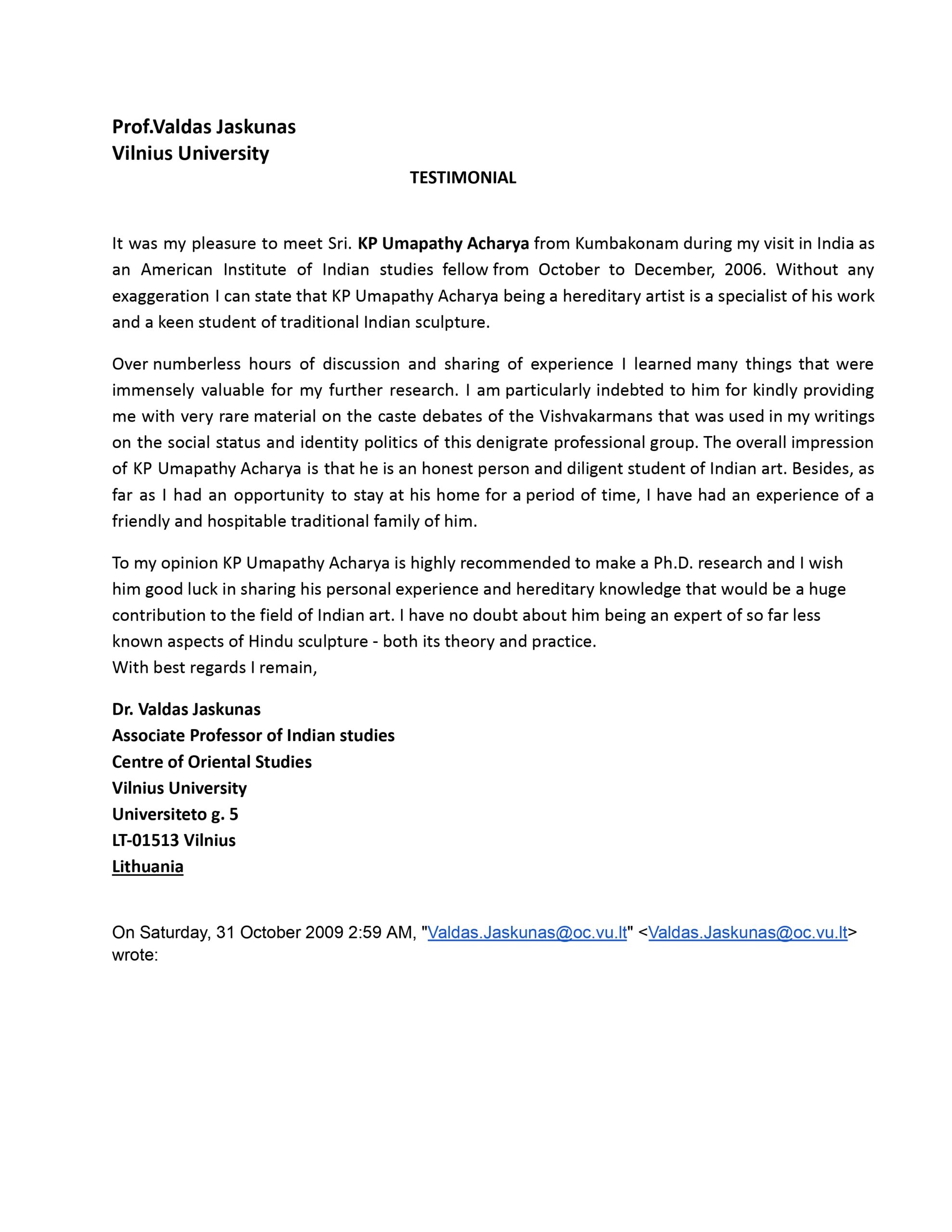
In the esteemed presence of Sri K. P. Umapathy Acharya, one encounters the living embodiment of the Vishwakarma tradition, where hereditary expertise meets rigorous intellectual inquiry. His mastery of both the sacred theory and practical application of Hindu sculpture offers a rare, profound insight into the social identity and spiritual depth of traditional craftsmanship. Through his generous sharing of ancestral knowledge, he continues to make a monumental contribution to the global understanding of Indian art and its enduring sanctity. To explore his journey and contributions in greater depth, kindly proceed to the detailed profile.
 Dr. Valdas Jaskunas
Associate Professor of Indian Studies,
Centre of Oriental Studies,
Vilnius University
Lithuania, 2009
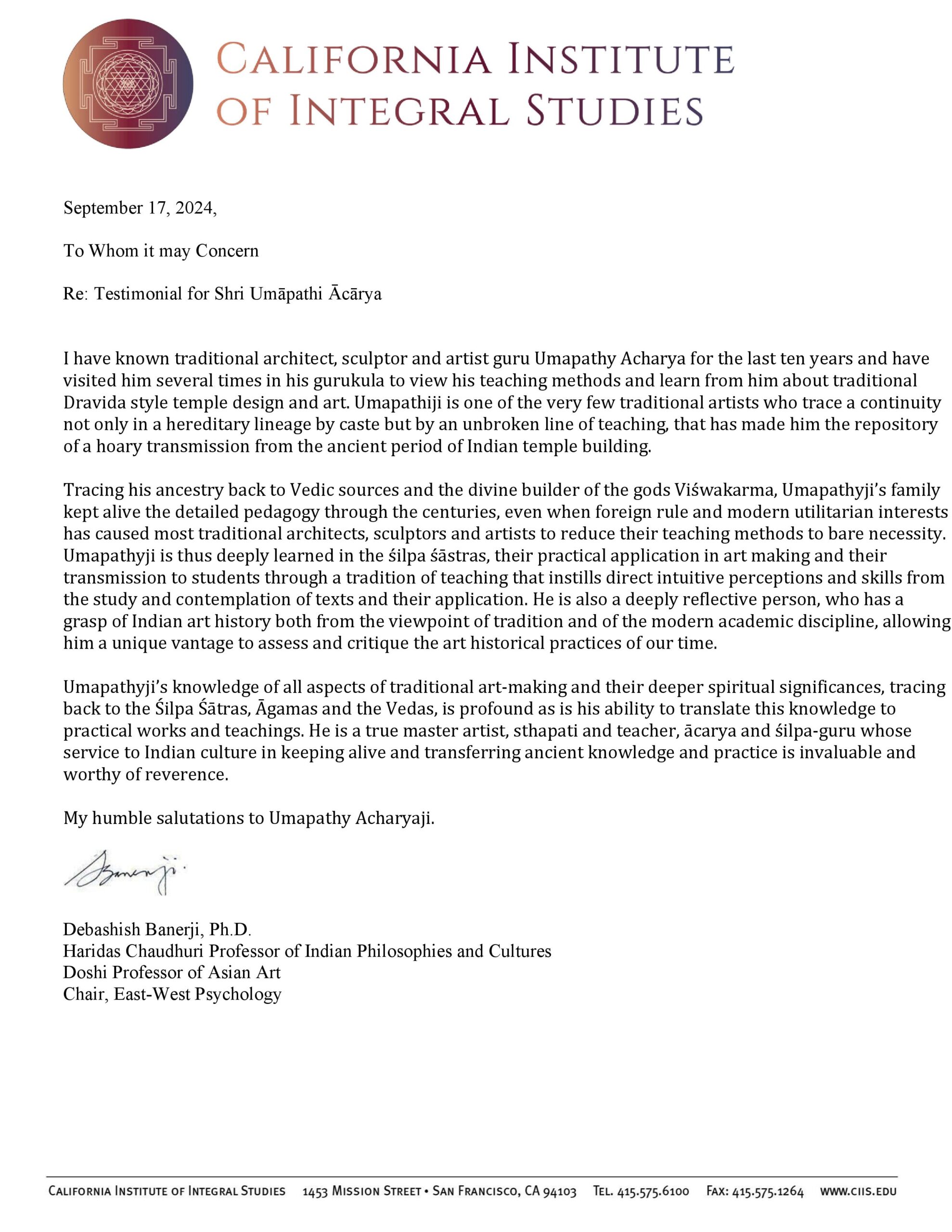
Shri Umapathy Ācārya stands as a luminous bearer of the Sthapatya tradition, embodying sacred artistry rooted in Vedic wisdom.
His mastery of the śilpa śāstras and devotion to divine craftsmanship reflect a rare confluence of spiritual insight and architectural precision.
Through teaching and practice, he transmits ancestral knowledge with reverence, nurturing innovation within the bounds of tradition.
His work is a living homage to the divine builder’s lore, preserving India’s sacred architectural heritage with unwavering fidelity.
 Dr. Debashish Banerji
Chair, East-West Psychology Department,
California Institute of Integral Studies
San Francisco, 2024
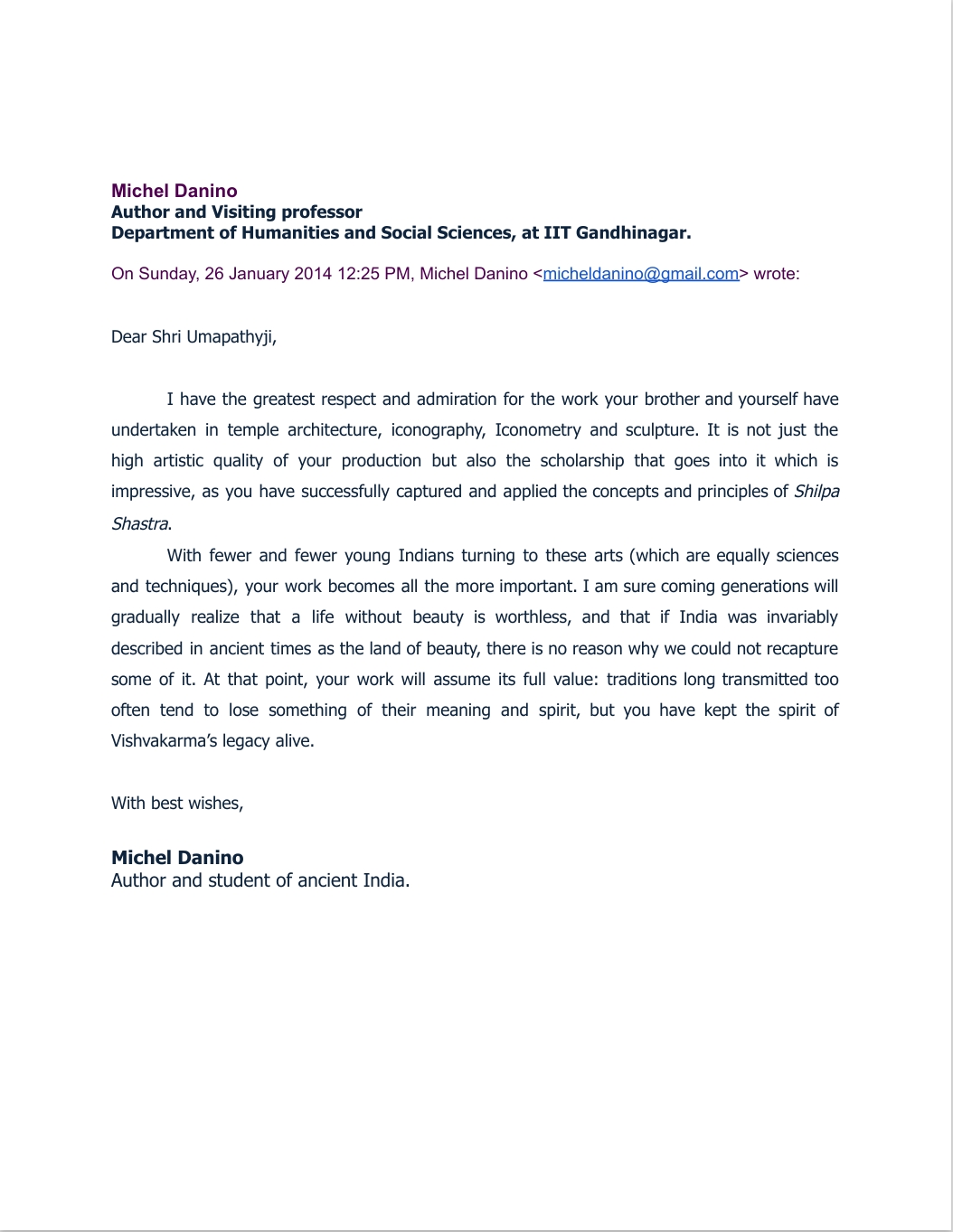
I have the greatest respect and admiration for the work your brother and yourself have undertaken in temple architecture, iconography, Iconometry and sculpture. It is not just the high artistic quality of your production but also the scholarship that goes into it which is impressive, as you have successfully captured and applied the concepts and principles of Shilpa Shastra.
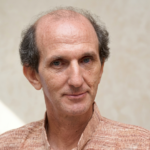 Michel Danino
Author and Visiting Professor,
IIT Gandhinagar
Gandhinagar, 2014
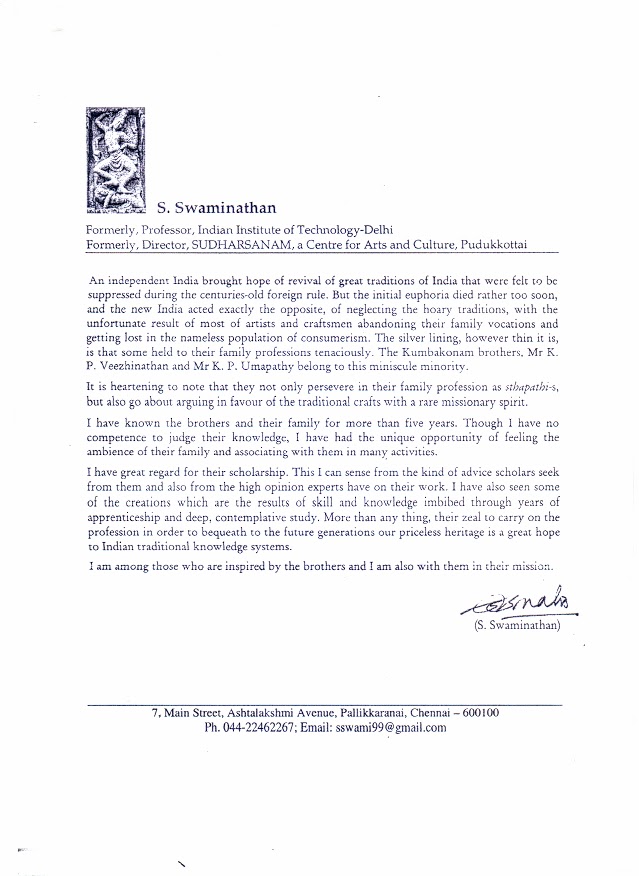
In an age when many ancient vocations have faded, Shri K.P. Umapathy Acharya of Kumbakonam stands as a rare torchbearer of the Sthapatya tradition. His perseverance, scholarship, and sacred craftsmanship embody the spiritual artistry and ancestral wisdom of Shilpa Shastra, offering hope for the preservation of India’s timeless heritage. Through his creations and missionary spirit, he inspires scholars and devotees alike with a vision rooted in devotion and continuity.
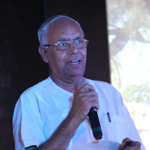 Prof S. Swaminathan
Formerly, Professor,
Indian Institute of Technology–Delhi;
Pudukkottai
Chennai,
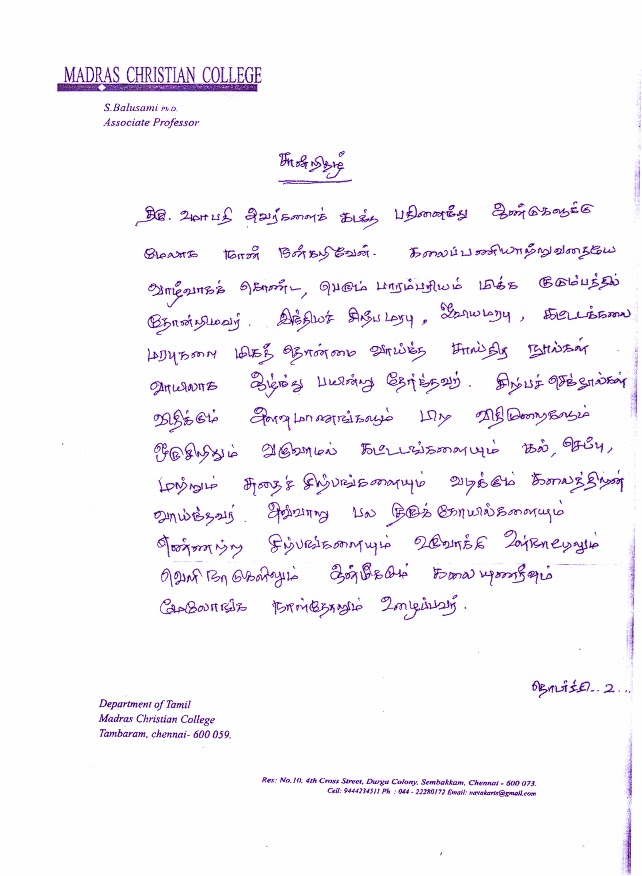
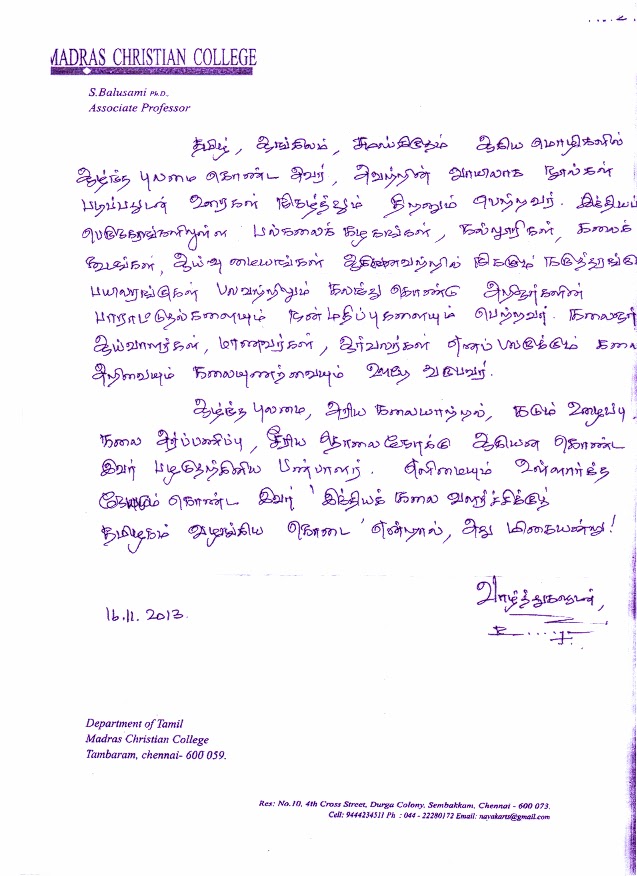
திரு. கே.பி. உமாபதி ஆச்சார்யா அவர்கள், பாரம்பரிய சிற்பக் குடும்பத்தில் தோன்றி, இந்தியச் சிற்பம், ஓவியம், கட்டடக் கலை ஆகிய மரபுகளை தொன்மை வாய்ந்த சாஸ்திர நூல்களின் வழியாக ஆழ்ந்து பயின்று தேர்ச்சி பெற்றவர். கல், சுதைச் சிற்பங்களிலும், திருக்கோயில்களிலும் அவர் வெளிப்படுத்திய கலைப்பணி, ஆன்மீகக் கலை உணர்வை உள்நாட்டிலும் வெளிநாடுகளிலும் உயர்த்துகிறது. தமிழ், ஆங்கிலம், சமஸ்கிருதம் ஆகிய மொழிகளில் புலமை பெற்ற அவர், கருத்தரங்குகள் மற்றும் ஆய்வரங்குகளில் அறிஞர்களின் பாராட்டைப் பெற்றுள்ளார். ஆழ்ந்த புலமை, அரிய கலைத்திறன், எளிமை, அர்ப்பணிப்பு ஆகியவற்றால், இந்தியக் கலை வளர்ச்சிக்கு தமிழகம் வழங்கிய அரிய கொடையாக அவர் விளங்குகிறார்.
 Dr.S. பாலுசாமி.
தமிழ்துறை,
சென்னை கிறிஸ்தவக் கல்லூரி (MCC),
தாம்பரம்
சென்னை, 2013
Read Translation
Mr. K. P. Umapathy Acharya, born into a traditional family of sculptors, has attained mastery in the classical traditions of Indian sculpture, painting, and architecture through deep study of ancient Śāstra texts. His artistic works in stone and stucco sculptures, as well as in temple architecture, elevate the spiritual aesthetic experience both within India and abroad.
Proficient in Tamil, English, and Sanskrit, he has earned the appreciation of scholars through his participation in seminars and academic forums. With profound scholarship, rare artistic skill, simplicity, and dedication, he stands as a precious contribution from Tamil Nadu to the growth of Indian art.
Dr.S. Balusamy,
Department of Tamil
Madras Christian College (MCC)
Tambaram, Chennai
2013
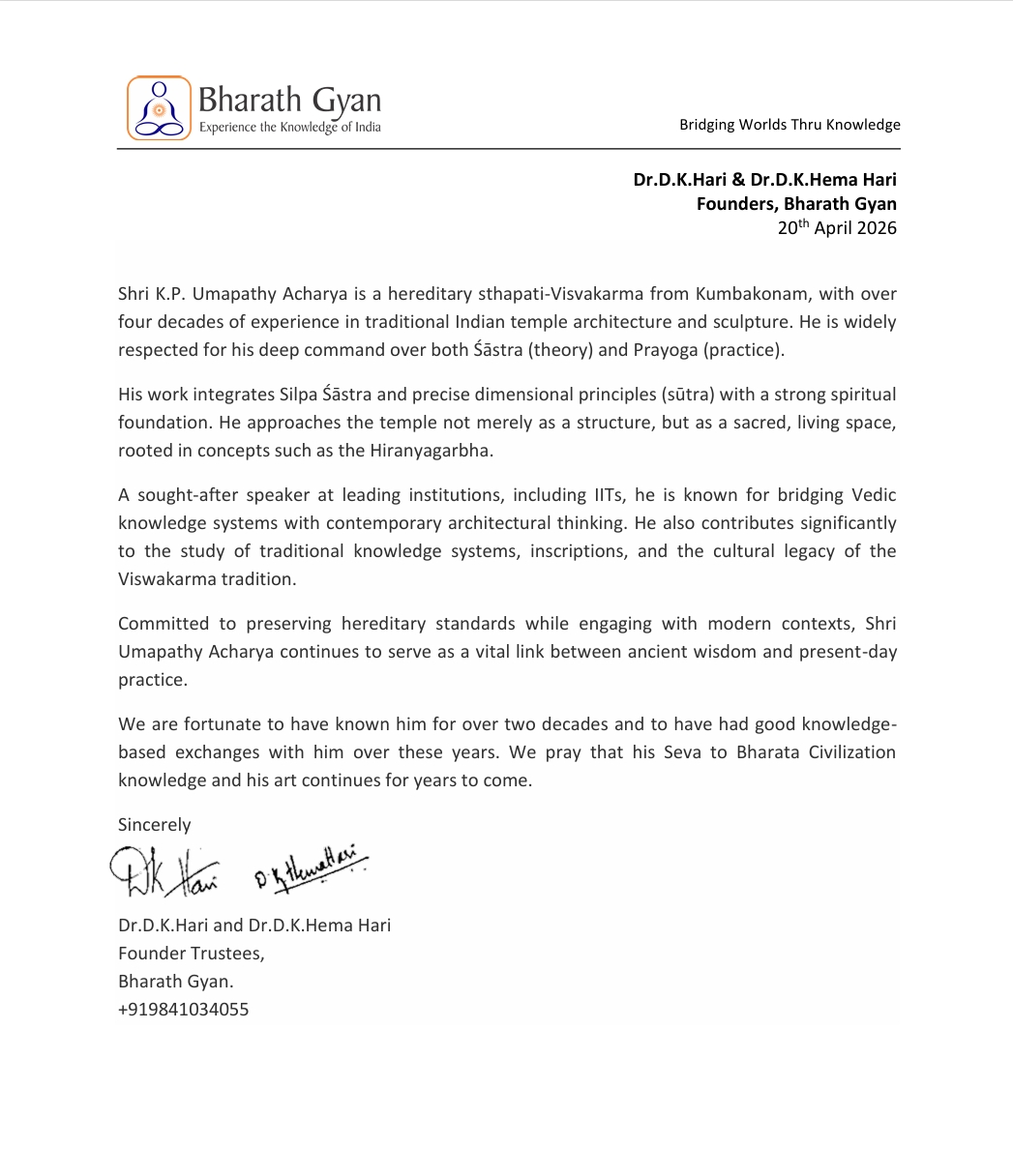
A master of the Viswakarma tradition, Shri K.P. Umapathy Acharya breathes life into stone, seamlessly weaving the sacred principles of Śilpa Śāstra with a profound spiritual foundation. His craftsmanship transcends mere structure, manifesting the Hiranyagarbha to create living spaces that serve as bridges between ancient Vedic wisdom and contemporary architectural thought. Rooted in four decades of hereditary expertise, his work remains a timeless testament to the preservation of Sthapatya heritage and the pursuit of divine artistry.
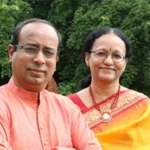 Dr. D.K. Hari & Dr. D.K. Hema Hari
Founders, Bharath Gyan
Chennai, 2026
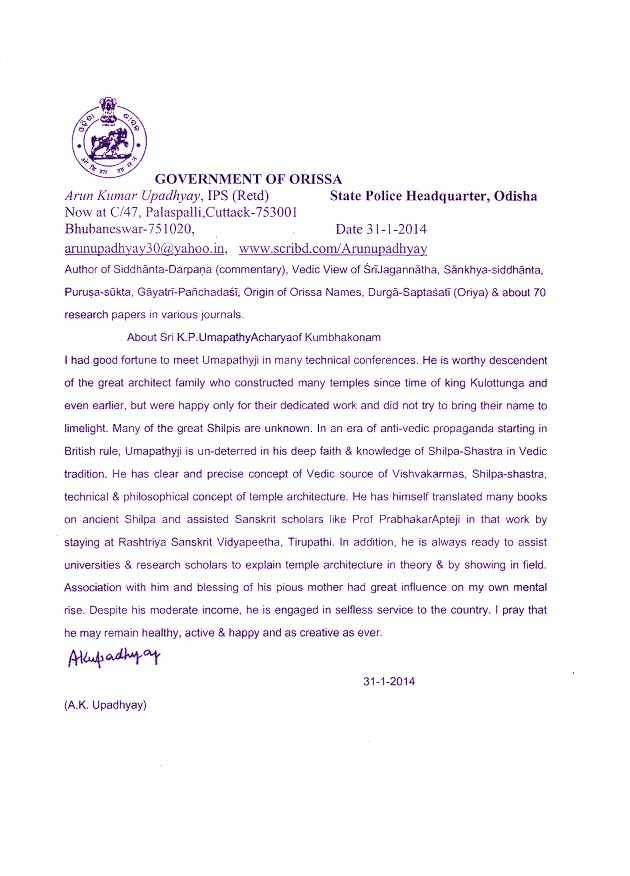
Shri K.P. Umapathy Acharya of Kumbakonam stands as a worthy descendant of the illustrious lineage of temple architects, whose sacred craftsmanship has flourished since the era of Kings. Undeterred by modern neglect of Vedic traditions, he embodies deep faith and mastery in Shilpa Shastra, uniting technical precision with philosophical vision.
His translations of ancient texts and guidance to scholars and universities reflect a selfless devotion to preserving ancestral knowledge and spiritual artistry. To explore his journey and contributions in greater depth.
A.K. Upadhyay,IPS (Retd.),
Author & Researcher,
Government of Orissa
Bhubaneswar, 2014
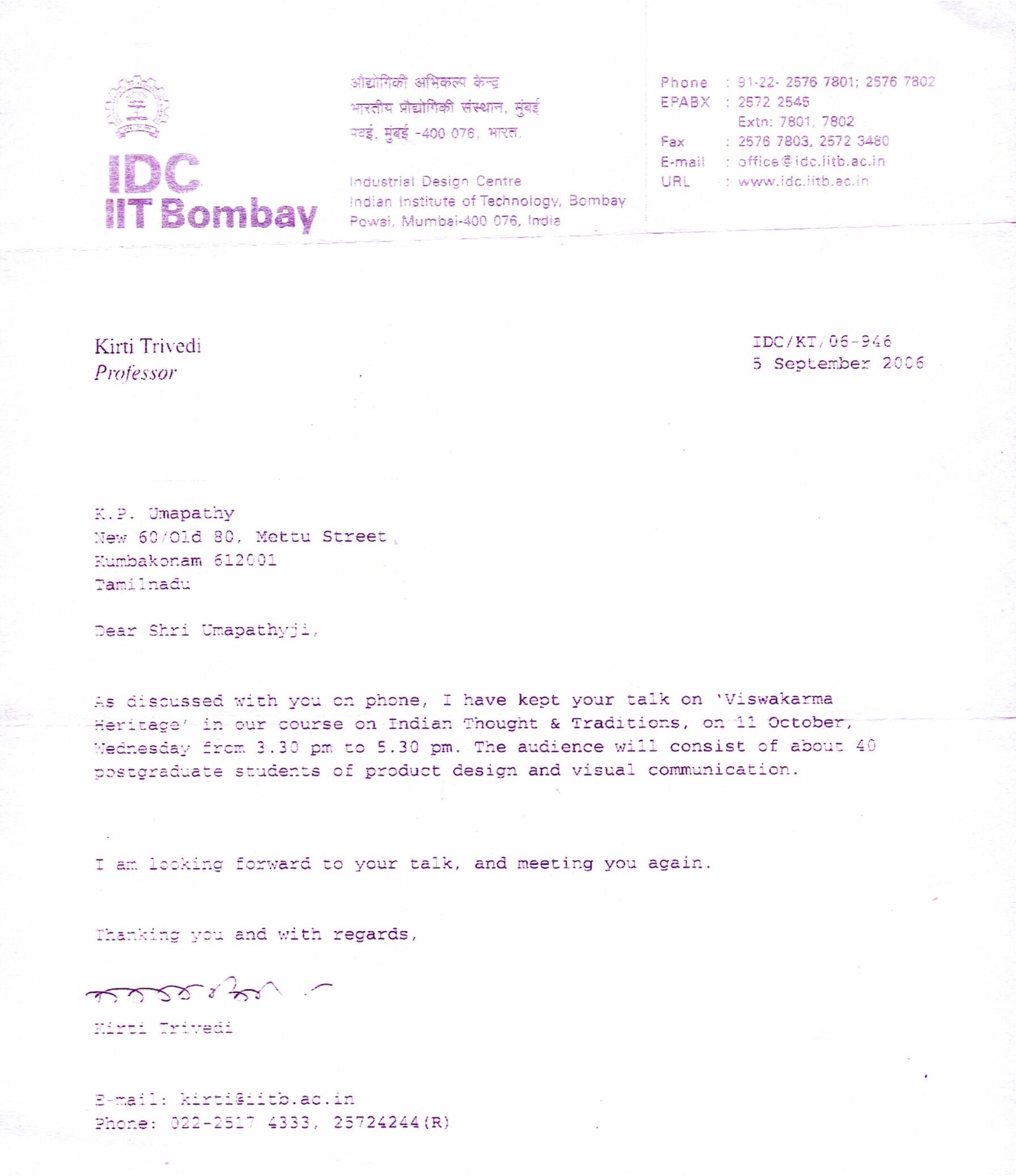
Dear Shri Umapathyji, As discussed with you on phone, I have kept your talk on “Viswakarma Heritage” in our course on Indian Thought & Traditions, on 11 October, Wednesday from 3.30 pm to 6.30 pm. The audience will consist of about 40 postgraduate students of product design and visual communication. I am looking forward to your talk, and meeting you again. Thanking you and with regards.
 Prof. Kirti Trivedi
Professor, Industrial Design Centre,
Indian Institute of Technology Bombay
Mumbai, 2006
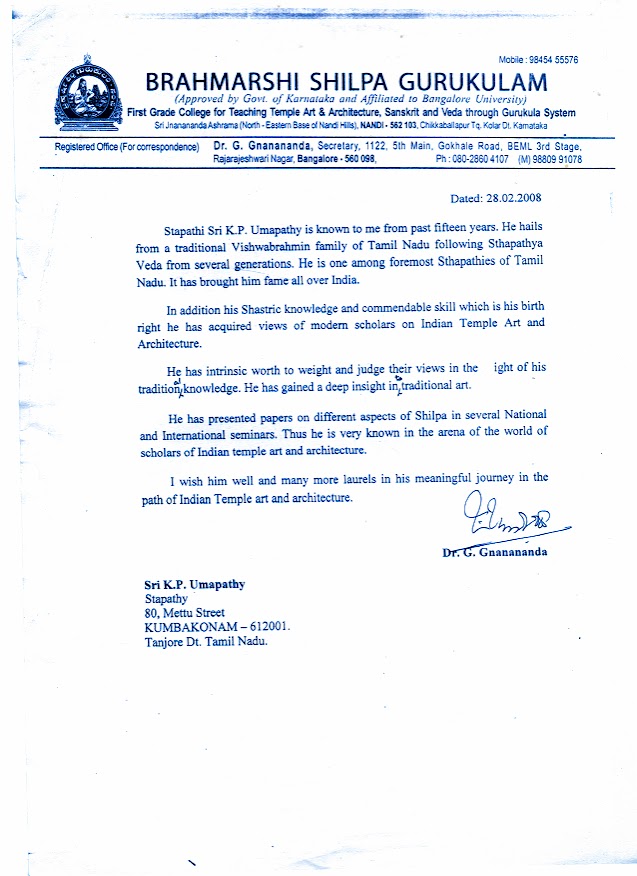
Sri K. P. Umapathy Sthapati hails from a revered Vishwabrahmin lineage of Tamil Nadu, upholding the sacred Sthapatya Veda tradition.
His mastery of Śāstric knowledge and modern architectural insights makes him one of the foremost Sthapatis of India.
Through numerous national and international seminars, he has shared profound wisdom on temple art and architecture.
A scholar and craftsman, he continues a meaningful journey in preserving India’s spiritual art heritage.
 Dr. G. Gnanananda
Founder & President,
Brahmarshi Śilpa Gurukulam
(Bangalore University)
Bangalore, 2008
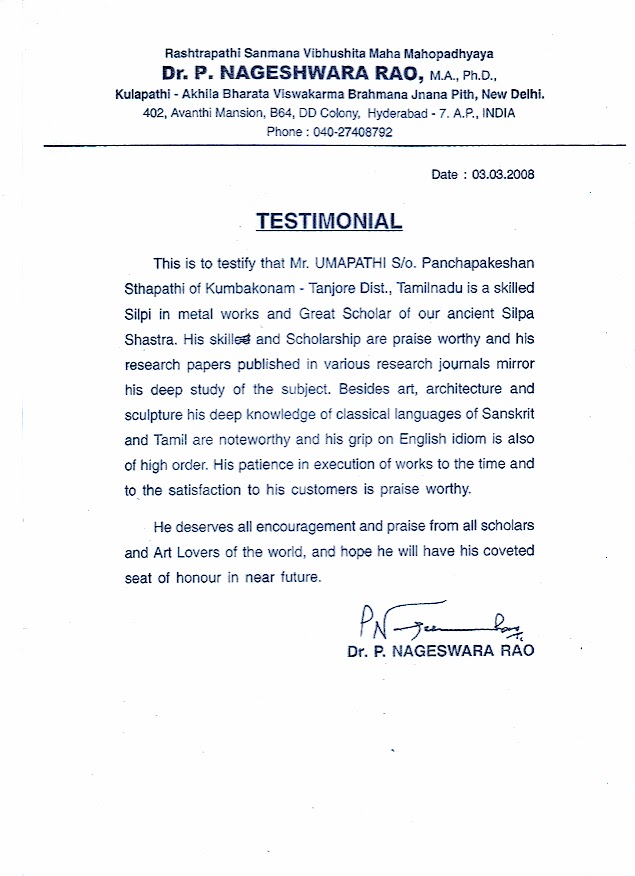
Mr. Umapathi, son of Panchapakeshan Sthapathi of Kumbakonam, is a revered Silpi whose mastery in metalwork and profound scholarship in Silpa Shastra reflect the sacred lineage of Viswakarma tradition. His deep command of Sanskrit, Tamil, and English, coupled with his devotion to classical art, architecture, and sculpture, exemplifies the timeless spirit of spiritual craftsmanship. His works, executed with patience and precision, have earned admiration from scholars and connoisseurs alike.
Dr. P. Nageswara Rao
Kulapathi –
Akhila Bharata Viswakarma Brahmana Jnana Pith,
New Delhi
Hyderabad, 2008
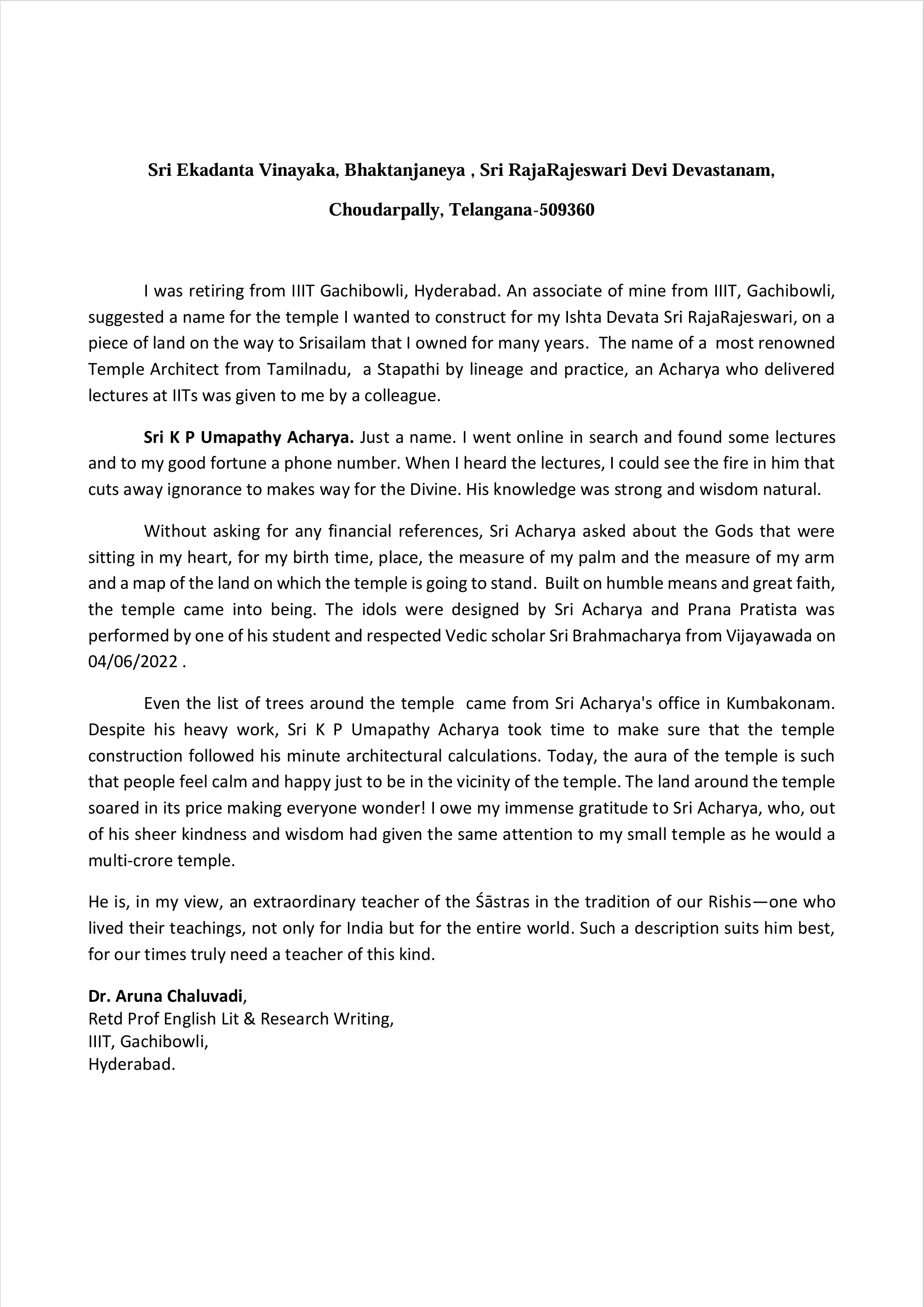
Through his profound mastery of Shilpa Shastra, Sri K. P. Umapathy Acharya transforms stone into a vessel for the Divine, guided by the precise architectural calculations of the Rishis. His selfless dedication to sacred craftsmanship ensures that even the humblest shrine resonates with spiritual aura and ancestral wisdom, bridging the gap between ancient lineage and modern faith. By harmonizing Vedic discipline with a teacher’s generosity, he continues to restore the sanctity of our traditional landscapes for generations to come. To explore his journey and contributions in greater depth, kindly proceed to the detailed profile.
Dr. Aruna Chaluvadi
Rtd Professor of English Literature & Research Writing,
IIIT Gachibowli
Hyderabad, 2022
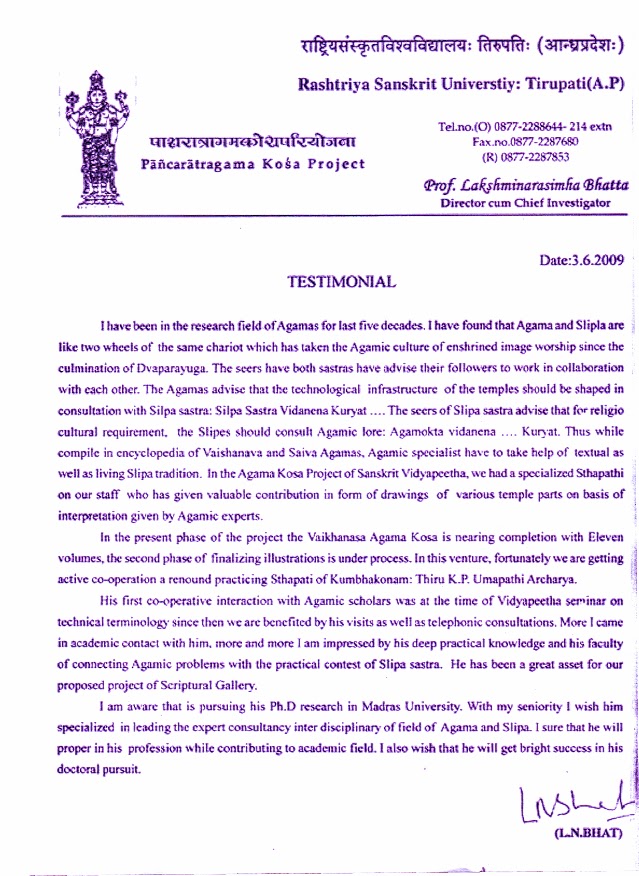
In the sacred confluence of Agama and Shilpa Shastra—two wheels of the same divine chariot—Shri K.P. Umapathi Acharya of Kumbhakonam has offered invaluable service. His deep practical knowledge and ability to harmonize Agamic principles with the living tradition of Shilpa have greatly enriched the Pāñcarātragama Kośa Project at Rashtriya Sanskrit Vidyapeetha, Tirupati. Through his scholarly guidance, illustrations, and consultations, he has become a vital asset in preserving and transmitting the spiritual artistry of temple architecture. To explore his journey and contributions in greater depth.
Prof. Lakshminarasimha Bhatta
Director & Chief Investigator,
Pāñcarātragama Kośa Project,
Rashtriya Sanskrit University,
Tirupati, 2009
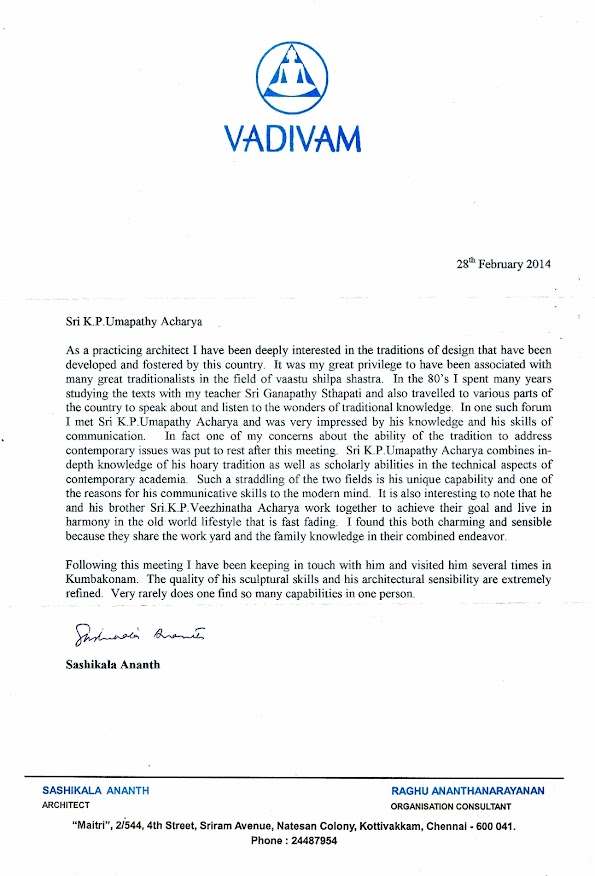
Sri K.P. Umapathy Acharya of Kumbakonam stands as a rare confluence of ancestral wisdom and modern scholarship, embodying the living spirit of Vaastu Shilpa Shastra. His refined sculptural artistry, architectural insight, and eloquence in conveying traditional knowledge to contemporary minds mark him as a true torchbearer of the Vishwakarma lineage. To explore his journey and contributions in greater depth.
Sashikala Ananth
Architect – Vadivam, Chennai
Chennai, 2014
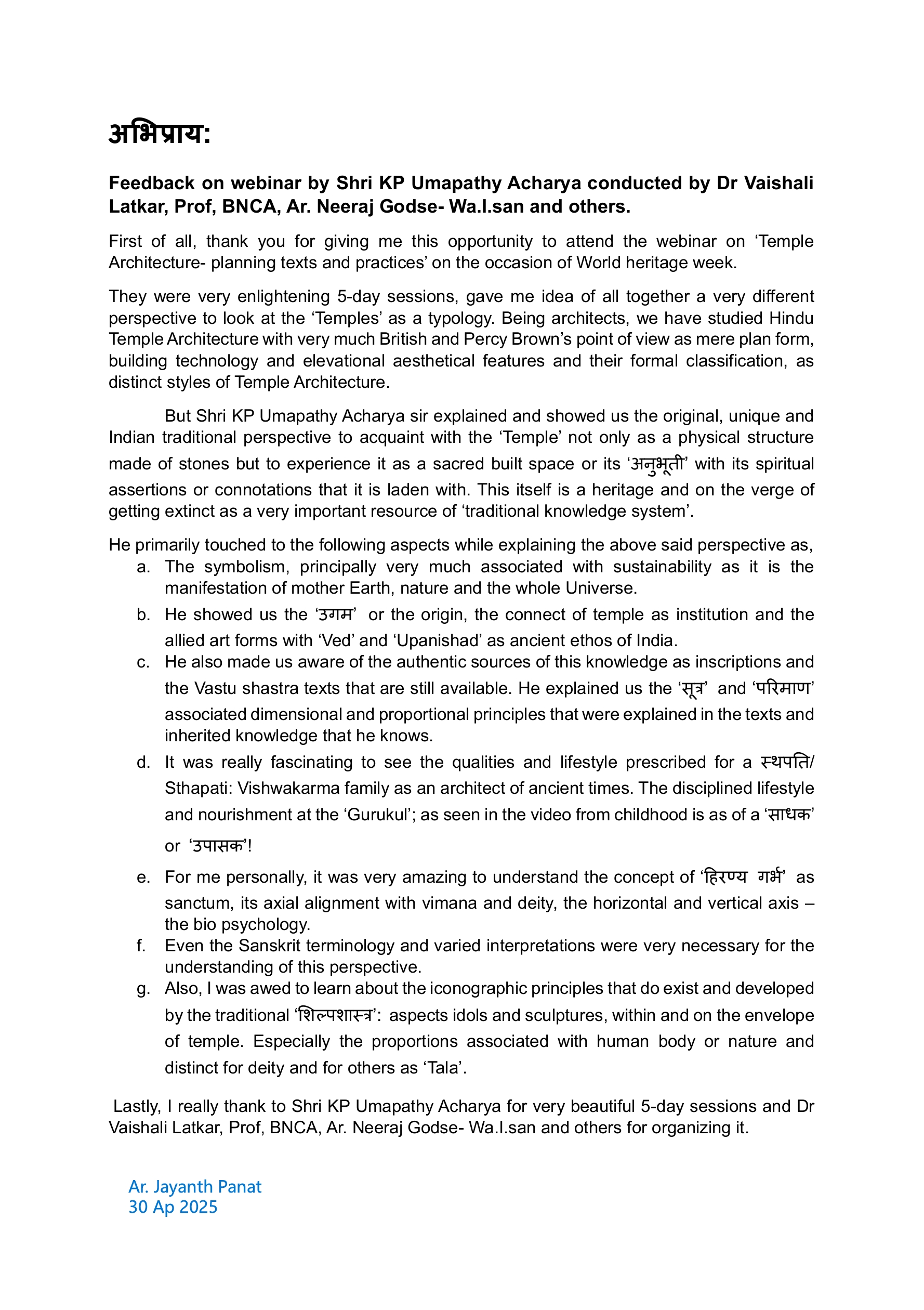
Shri K.P. Umapathy Acharya is a distinguished Sthapati whose teachings during the World Heritage Week webinar unveiled the temple not merely as a structure, but as a sacred embodiment of cosmic order and spiritual resonance.
His exposition bridged ancient Vedic symbolism, Vastushastra proportions, and iconographic precision—revealing the temple as a living yantra of divine consciousness.
From the Hiranyagarbha sanctum’s metaphysical alignment to the disciplined life of the Vishwakarma artisan, every insight reflected a lineage of devotion, sustainability, and sacred geometry.
Ar. Jayanth Panat
Architect and Participant –
World Heritage Week Webinar
India, 2025
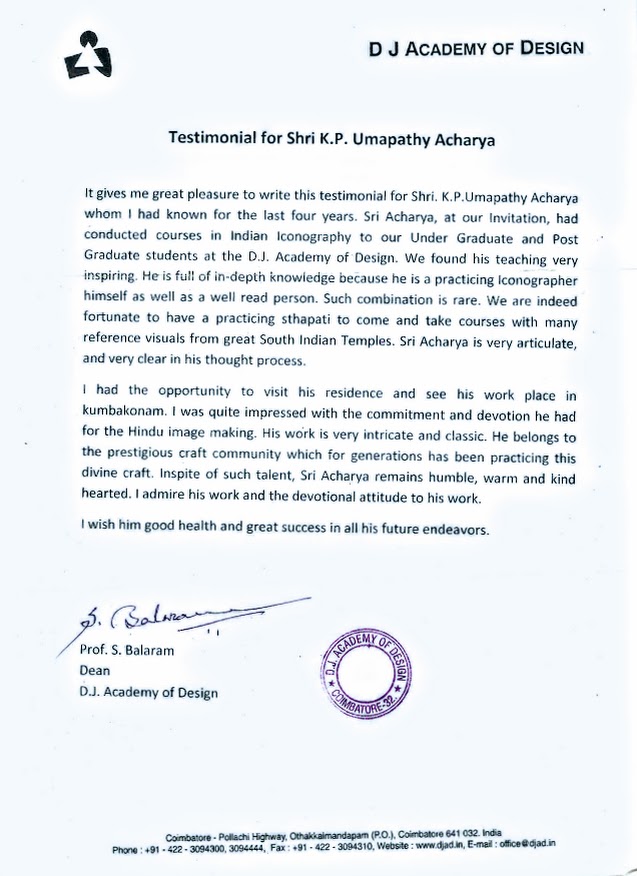
Shri K.P. Umapathy Acharya, a revered practicing Sthapati and Iconographer from Kumbakonam, has imparted the sacred wisdom of Indian Iconography to students at DJ Academy of Design with clarity, depth, and devotion.
His intricate craftsmanship and ancestral dedication to Hindu image-making reflect the timeless spirit of the Vishwakarma tradition. Despite his mastery, he remains humble and warm, embodying the grace of a true spiritual artisan.
 Prof. S. Balaram
Dean – DJ Academy of Design,
Coimbatore
Coimbatore, 2014
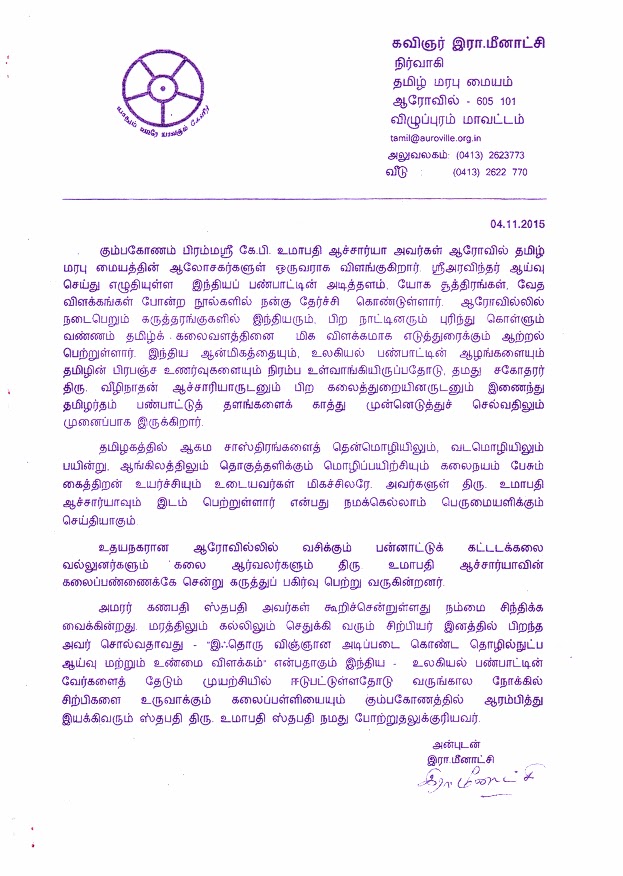
கும்பகோணம் பிரம்மஸ்ரீ கே.பி. உமாபதி ஆச்சார்யா அவர்கள், ஆரோவில் தமிழ் மரபு மையத்தின் ஆலோசகராக விளங்குகிறார். யோக சூத்திரங்கள், வேத விளக்கங்கள் மற்றும் ஆகம சாஸ்திரங்களில் தேர்ச்சி பெற்ற அவர், இந்திய ஆன்மிகம், உலகியல்பண்பாடு மற்றும் தமிழின் பிரபஞ்ச உணர்வுகளை ஆழமாக எடுத்துரைக்கும் திறன் கொண்டவர்.
இவர் பாரம்பரியக் கலைத்தளங்களை காத்து முன்னெடுத்துச் செல்லும் அவரது பணி, மரபு அறிவும், கலைநயமும், ஆன்மிகக் கைவண்ணமும் ஒன்றிணைந்த புனிதச் செயற்பாடாகும். எதிர்கால தலைமுறைகளுக்காக கலைப்பள்ளி நிறுவி, சிற்பிகளின் பாரம்பரியத்தை நிலைநிறுத்தும் அவரது முயற்சி, நம் அனைவருக்கும் பெருமை தருகிறது.
அவரது பயணம் மற்றும் பங்களிப்புகளை விரிவாக அறிய, தயவுசெய்து விரிவான சுயவிவரத்தைப் பார்க்கவும்.
இரா. மீனாட்சி
நிர்வாகி,
தமிழ் மரபு மையம், ஆரோவில்
விழுப்புரம், 2015
Read Translation
Brahmasri Kumbakonam K. P. Umapathy Acharya serves as an advisor to the Auroville Tamil Heritage Centre. Well-versed in the Yoga Sutras, Vedic interpretations, and Āgama Śāstras, he possesses a rare ability to articulate the deeper dimensions of Indian spirituality, global culture, and the cosmic vision embedded in Tamil thought.
He is devoted to preserving and advancing traditional artistic heritage. His work stands as a sacred confluence of traditional knowledge, artistic refinement, and spiritual craftsmanship.
His initiative to establish an art school for future generations, with the aim of sustaining the lineage of traditional sculptors, is a matter of great pride for all of us.
To learn more about his journey and contributions, you are invited to explore his detailed profile.
R. Meenakshi
Administrator
Tamil Heritage Centre,
Auroville
Villupuram , 2015
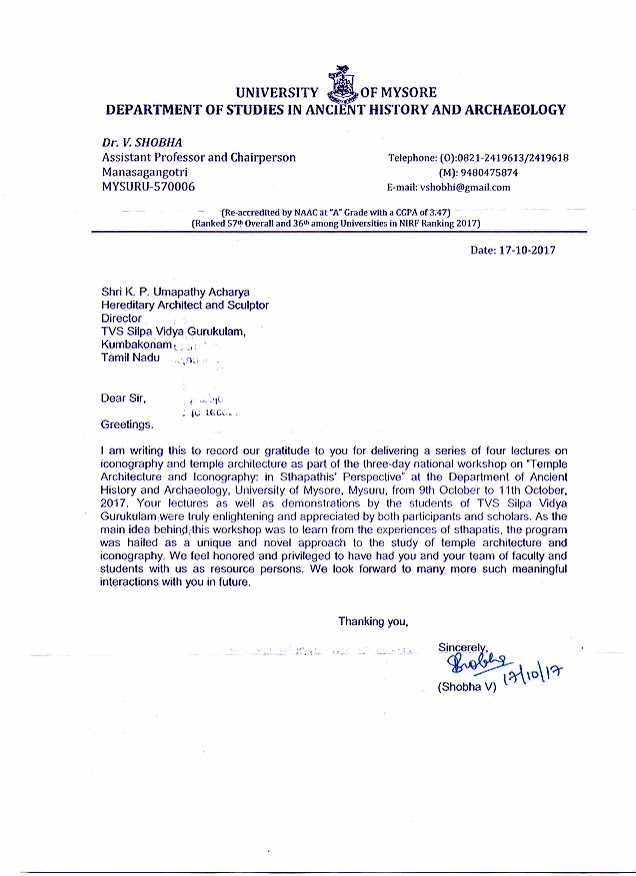
Shri K.P. Umapathy Acharya, hereditary architect and sculptor, enriched the National Workshop on Temple Architecture and Iconography in Sthapathis’ Perspective at the University of Mysore with a series of profound lectures and live demonstrations. His teachings, together with the contributions of students from Silpa Vidya Gurukulam, illuminated the sacred artistry of iconography and temple design, offering scholars and participants a rare glimpse into the living continuity of the Sthapatya tradition. The program was hailed as a unique and devotional approach to understanding India’s architectural heritage.
Dr. V. Shobha
Assistant Professor & Chairperson,
Department of Ancient History and Archaeology,
University of Mysore
Mysuru, 2017
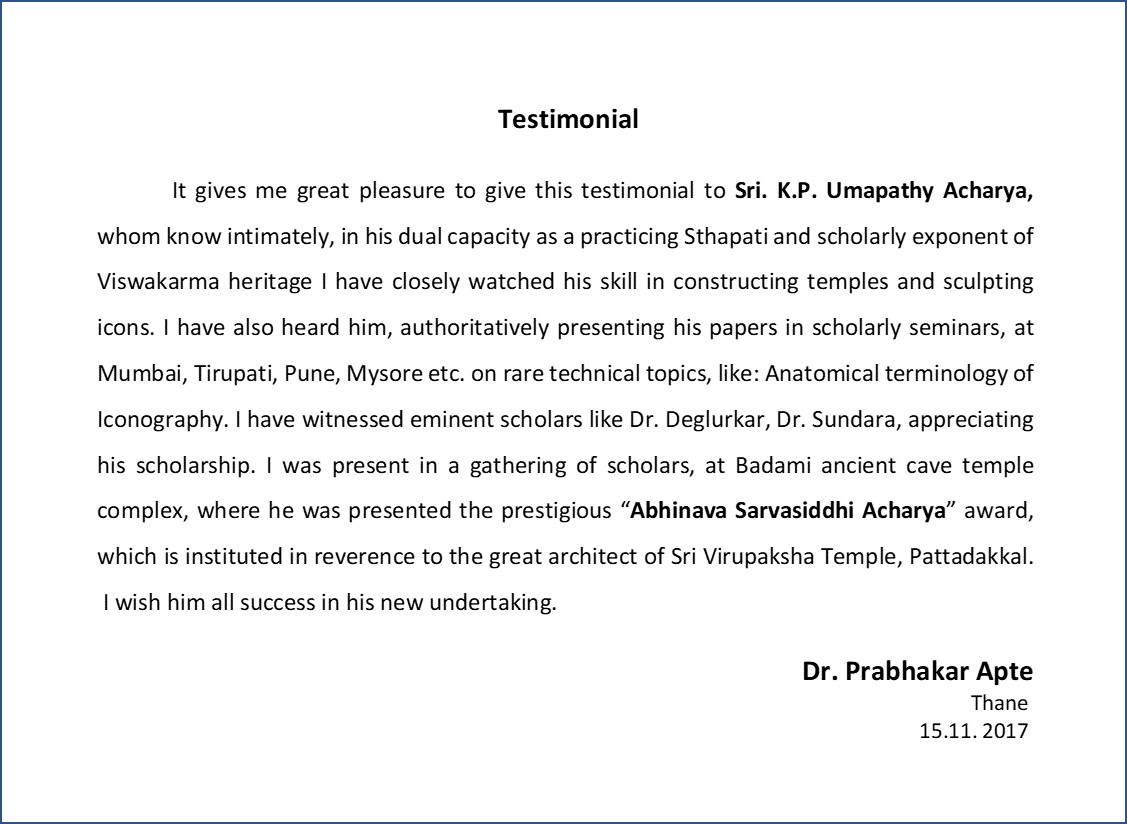
Sri K.P. Umapathy Acharya is a masterful Sthapati and erudite scholar of the Viswakarma tradition, whose temple architecture and iconographic expertise have earned acclaim across India. His rare insights into anatomical iconography and his recognition with the “Abhinava Sarvasiddhi Acharya” award at Badami affirm his stature among India’s foremost traditional artisans. His work continues the sacred lineage of Sri Virupaksha’s legacy with devotion and distinction.
To explore his journey and contributions in greater depth.
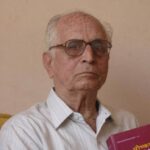 Dr. Prabhakar Apte
Scholar and CulturalCommentator
Thane, 2017
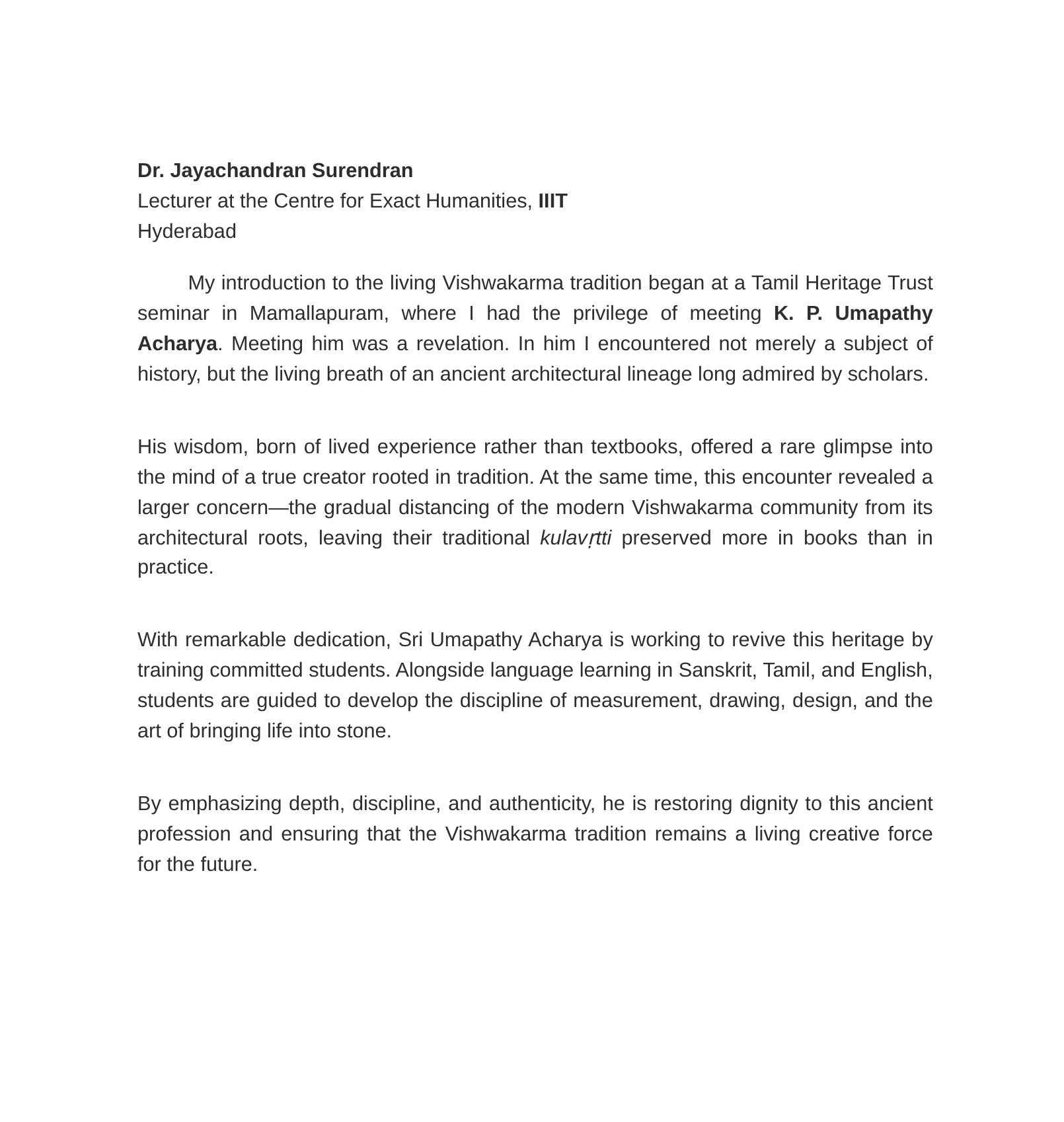
In the sacred footsteps of the Vishwakarma lineage, K.P. Umapathy Acharya serves as a living bridge to ancestral wisdom, manifesting spiritual artistry through disciplined craftsmanship. His work revitalizes the ancient kulavṛtti by harmonizing traditional design with the rigorous, sacred measurements required to bring life into stone. By mentoring a new generation in this deep tradition, Acharya ensures the Sthapatya heritage remains a vibrant, creative force. To explore his journey and contributions in greater depth, kindly proceed to the detailed profile.
 Dr. Jayachandran Surendran
Lecturer at the Centre for Exact Humanities, IIIT
Hyderabad
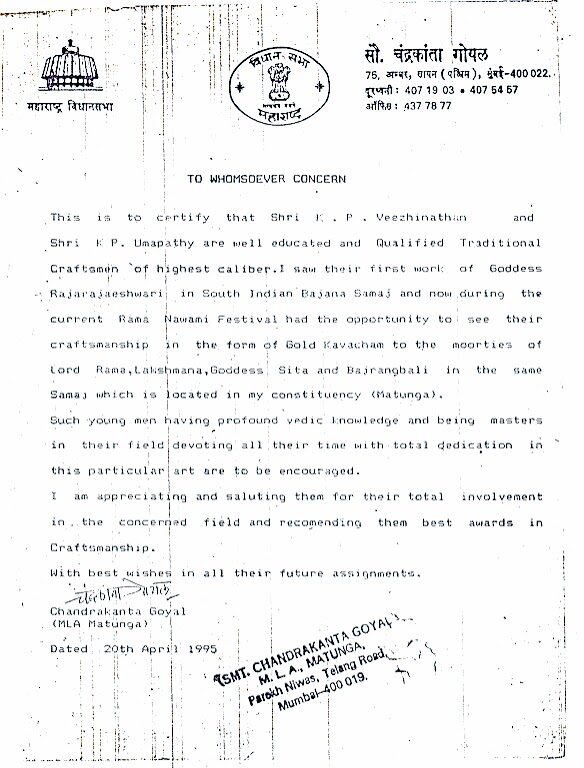
Shri K.P. Umapathy exemplifies the sacred artistry of traditional Indian craftsmanship, blending Vedic knowledge with exceptional devotion. Their divine works, including the gold Kavacham adorning Lord Rama, Sita, Lakshmana, and Hanuman, reflect both skill and sanctity. Through their dedication, they uphold the timeless heritage of Śilpaśāstra with grace and precision. Their artistry deserves the highest recognition and encouragement.
Chandrakanta Goyal
MLA, Matunga
Mumbai, 1995
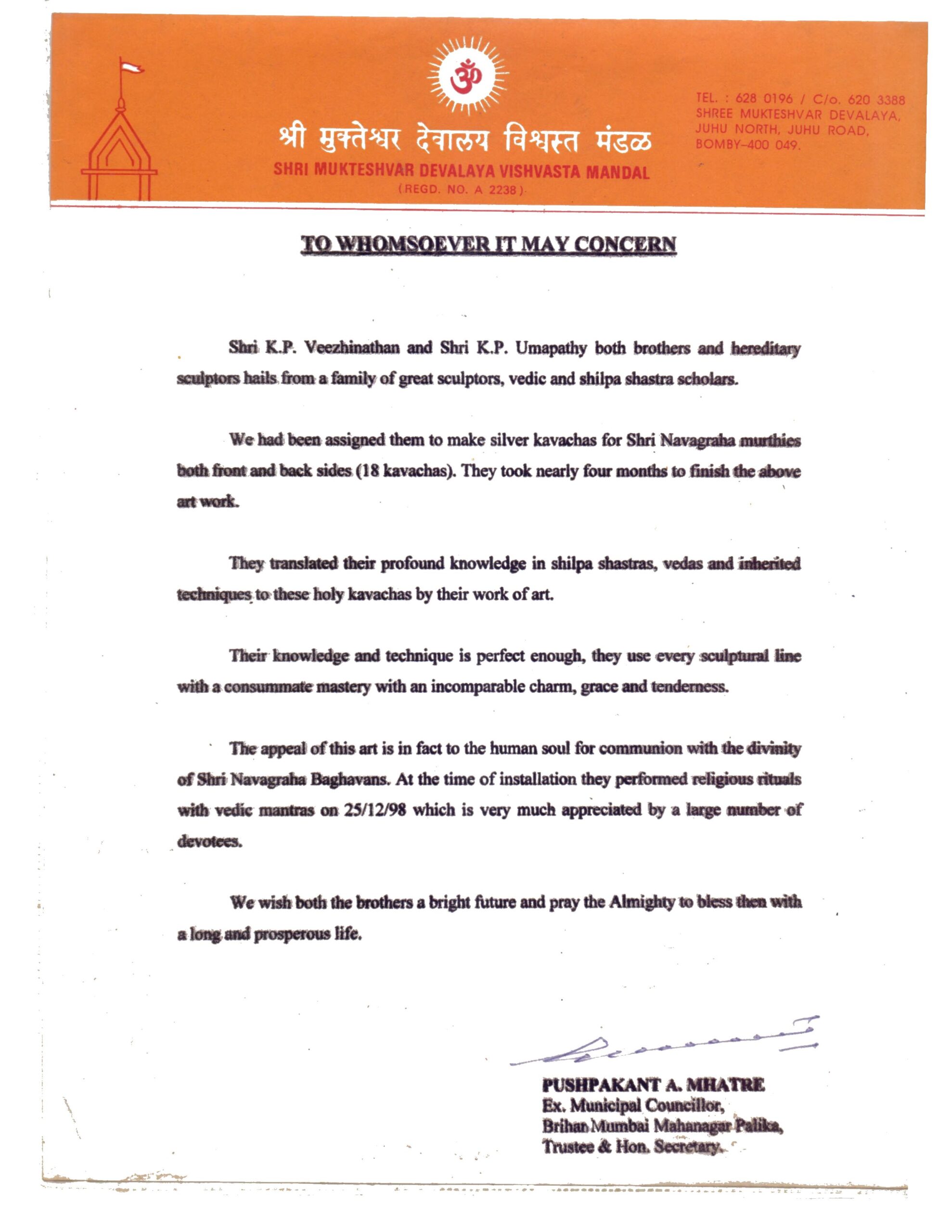
Rooted in the sacred lineage of hereditary sculptors and scholars of Veda and Shilpa Shastra, Shri K.P. Veezhinathan and Shri K.P. Umapathy embodies the timeless artistry of Sthapatya tradition. Their creation of silver kavachas for the Shri Navagraha murthies reflects ancestral wisdom, spiritual devotion, and consummate craftsmanship, where every sculptural line resonates with grace and divine communion. Through ritual sanctification with Vedic mantras, their work transcends ornamentation to become a sacred offering to the soul. To explore his journey and contributions in greater depth.
Pushpakant A. Mhatre
Ex. Municipal Councillor,
Brihan Mumbai Mahanagar Palika,
Trustee & Hon. Secretary
Bombay, 1998
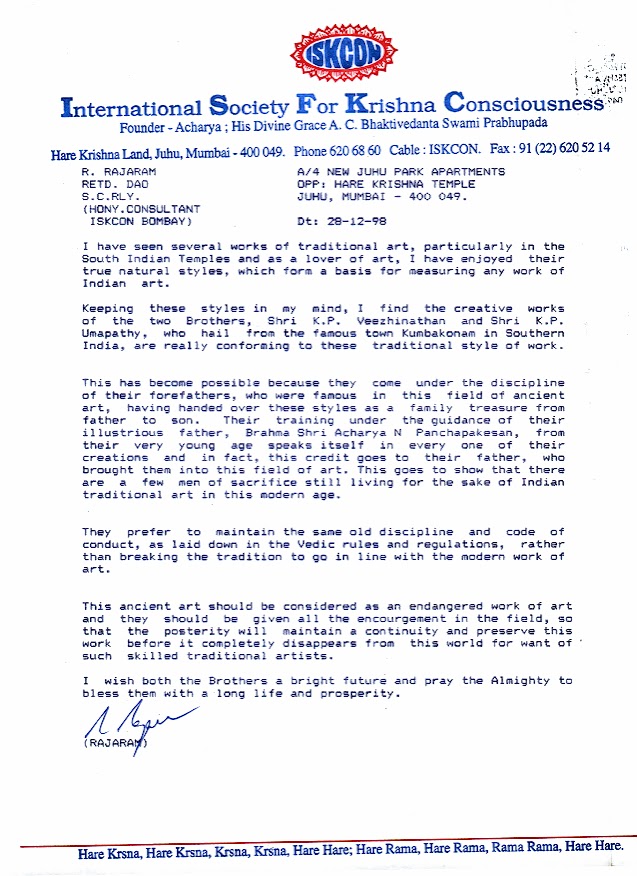
The traditional works of Shri K.P. Umapathy of Kumbakonam radiates the timeless spirit of South Indian temple artistry, blending devotion, discipline, and ancestral wisdom. Trained under sacred lineage and guided by Vedic principles, his creations uphold the essence of Śilpa with purity and reverence. His dedication preserves an endangered heritage, ensuring continuity of India’s divine artistic tradition. May his lineage of sacred craftsmanship endure and inspire generations to come.
R. Rajaram
Honorary Consultant,
ISKCON Bombay
Mumbai, 1998
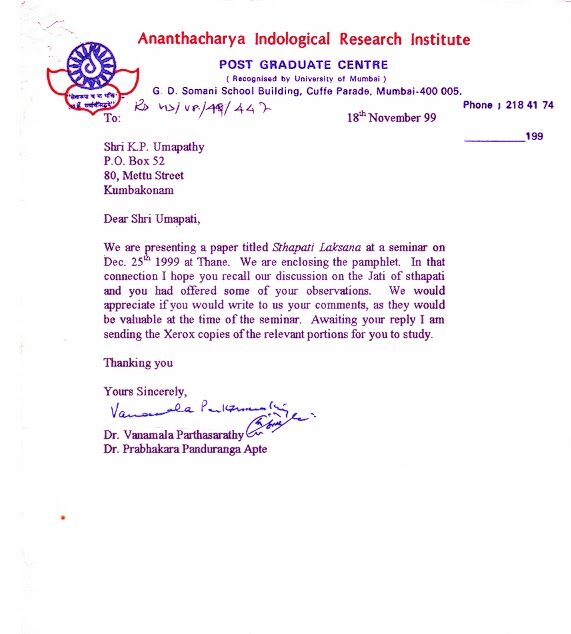
Shri K.P. Umapathy Acharya of Kumbakonam has been recognized for his insightful observations on the Jāti of Sthapati, contributing valuable perspectives to scholarly discussions on traditional architecture. His guidance was sought by the Ananthacharya Indological Research Institute in connection with their seminar on Sthapati Lakṣaṇa, affirming his role as a custodian of ancestral wisdom and sacred craftsmanship. His engagement reflects the living continuity of the Sthapatya tradition, where spiritual artistry and scholarly inquiry meet in service of heritage
Dr. Vanamala Parthasarathy
Dr. Prabhakara Panduranga Apte
Ananthacharya Indological Research Institute,
University of Mumbai
Mumbai, 1999
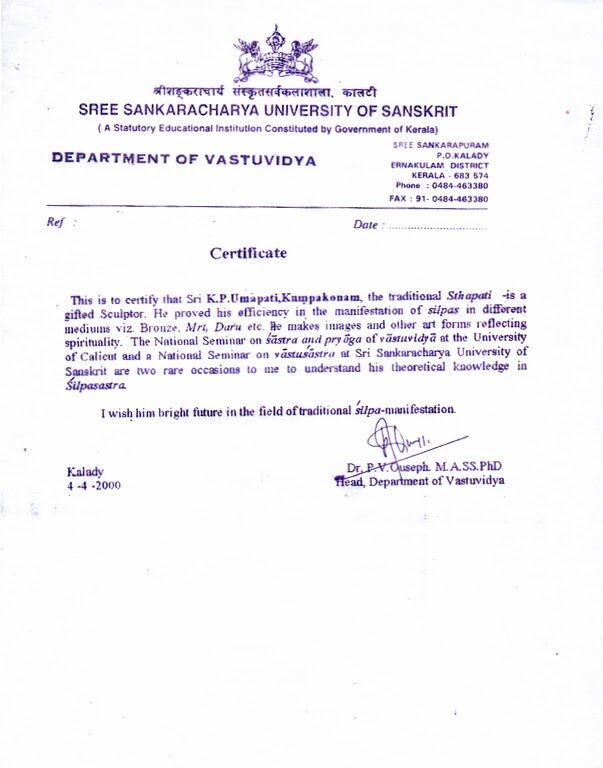
Sri K.P. Umapathy of Kumpakonam embodies the sacred spirit of Sthapatya, harmonizing artistic mastery with profound spiritual understanding. His sculptures in bronze, clay, and wood radiate devotion and timeless craftsmanship. Rooted in Śilpaśāstra and nourished by scholarly pursuit, his work reflects the seamless union of knowledge and creativity. He stands as a worthy bearer of India’s eternal architectural and sculptural lineage.
Dr. P. V. Ouseph
Head, Department of Vastuvvidya,
Sree Sankaracharya University of Sanskrit
Kalady, 2000
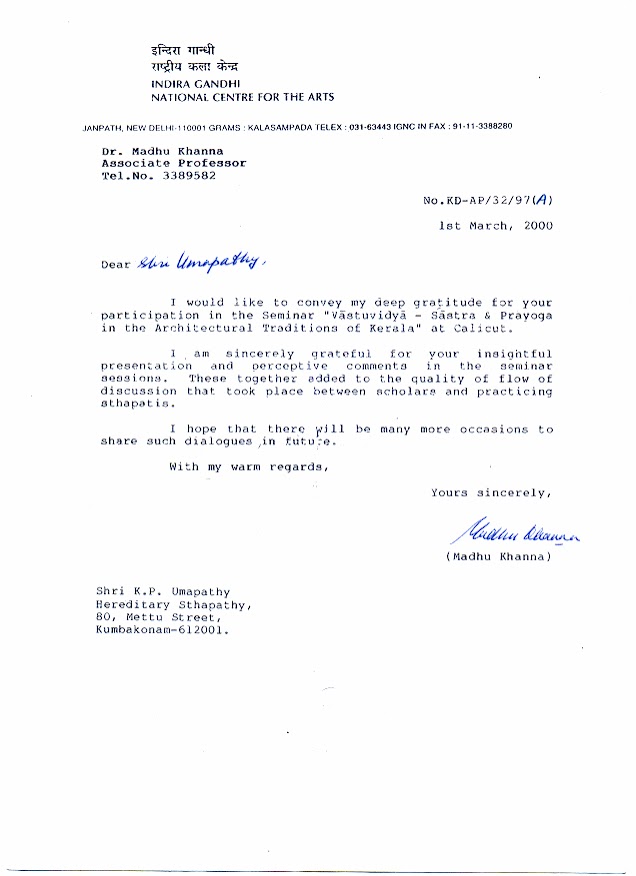
Shri K.P. Umapathy, a hereditary Sthapathy rooted in the sacred lineage of Shilpa Shastra, was invited to share his wisdom at the seminar “Vāstuvidya Śāstra & Prayoga in the Architectural Traditions of Kerala” held at Calicut. His insightful presentation and perceptive contributions enriched the dialogue between scholars and practicing sthapatis, weaving ancestral knowledge with living tradition. Such exchanges affirm the enduring spiritual artistry of Sthapatya, where scholarship and craftsmanship unite in service of the divine. To explore his journey and contributions in greater depth.
Dr. Madhu Khanna
Associate Professor,
Indira Gandhi National Centre for the Arts
New Delhi, 2000
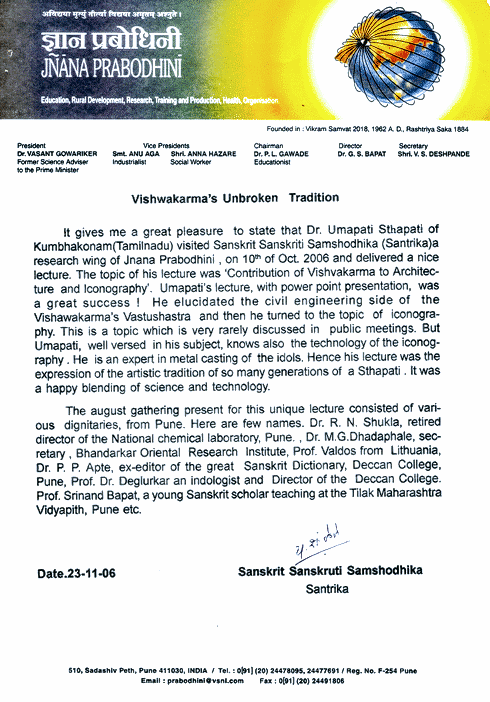
Umapati Sthapati of Kumbhakonam, Tamilnadu, delivered a distinguished lecture at Jnana Prabodhini’s Sanskriti Samshodhika on the sacred contributions of Vishwakarma to architecture and iconography. His presentation, blending ancestral artistry with technical precision, illuminated the rarely discussed science behind Vastushastra and idol casting. Revered by scholars and dignitaries alike, his insights reflected the living legacy of Sthapatya tradition.
Dr. Vasant Gowariker
President – Jnana Prabodhini, Pune
Pune, 2006
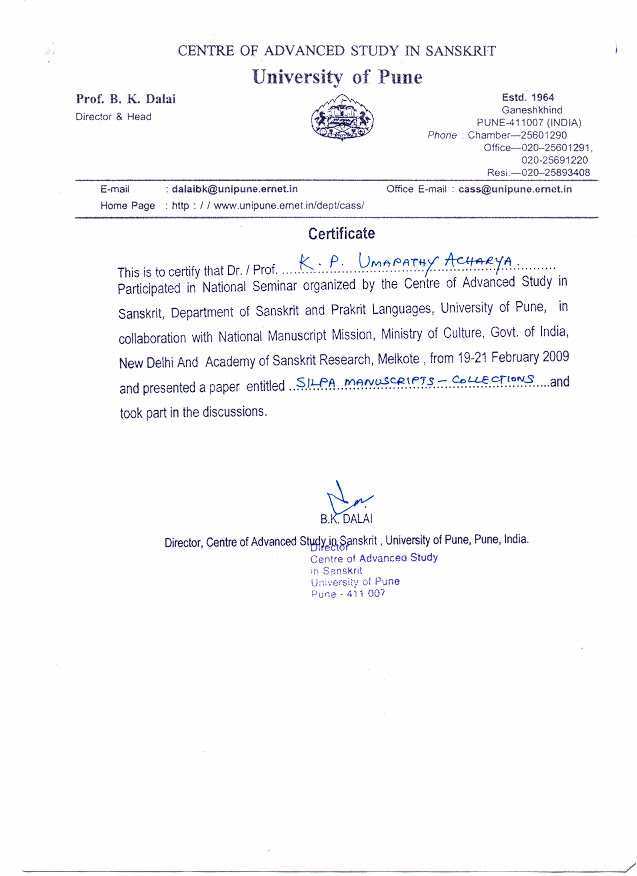
Shri K.P. Umapathy Acharya, rooted in the sacred lineage of Sthapatya, participated in the National Seminar on Sanskrit traditions organized by the Centre of Advanced Study in Sanskrit, University of Pune. His paper on Śilpa Manuscripts – Collections reflected ancestral knowledge and sacred craftsmanship, enriching scholarly dialogue with insights drawn from the timeless wisdom of Shilpa Shastra. His contribution stands as a testament to the spiritual artistry and continuity of India’s architectural heritage. To explore his journey and contributions in greater depth.
Prof. B.K. Dalai
Director & Head,
Centre of Advanced Study in Sanskrit,
University of Pune
Pune, 2009