Press
तत्त्वं भवति शिल्पम्। रहस्यं भवति शिल्पम्।
Tattvam Bhavati Śilpam | Rahasyam Bhavati Śilpam
“Architecture is the Essence of Truth. Architecture is the Beauty of Mystery.”
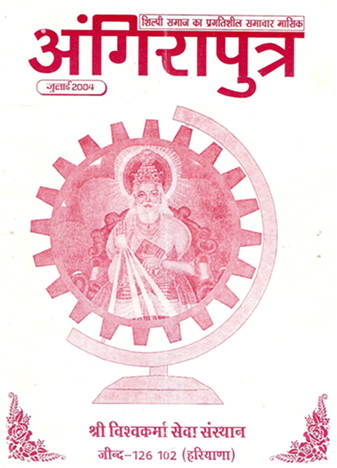
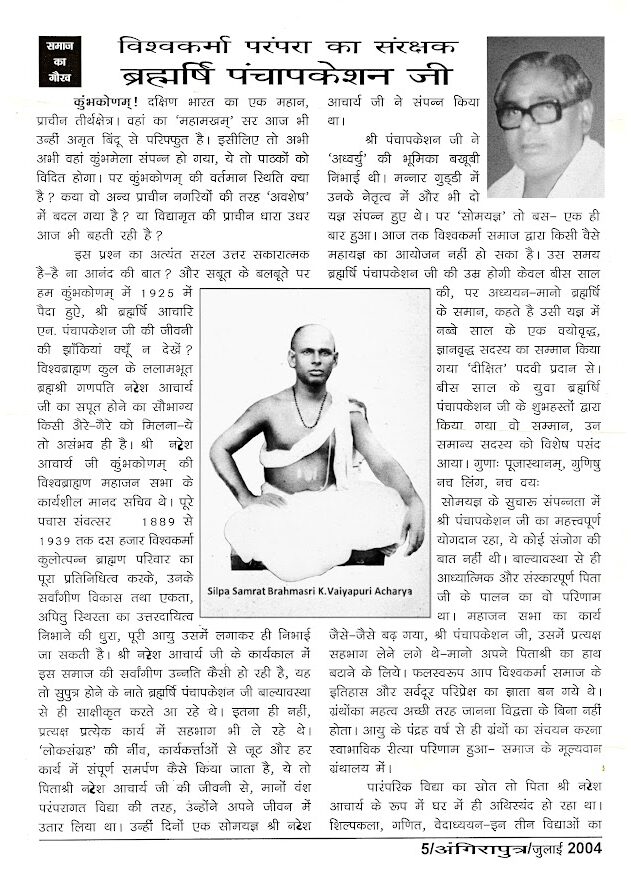
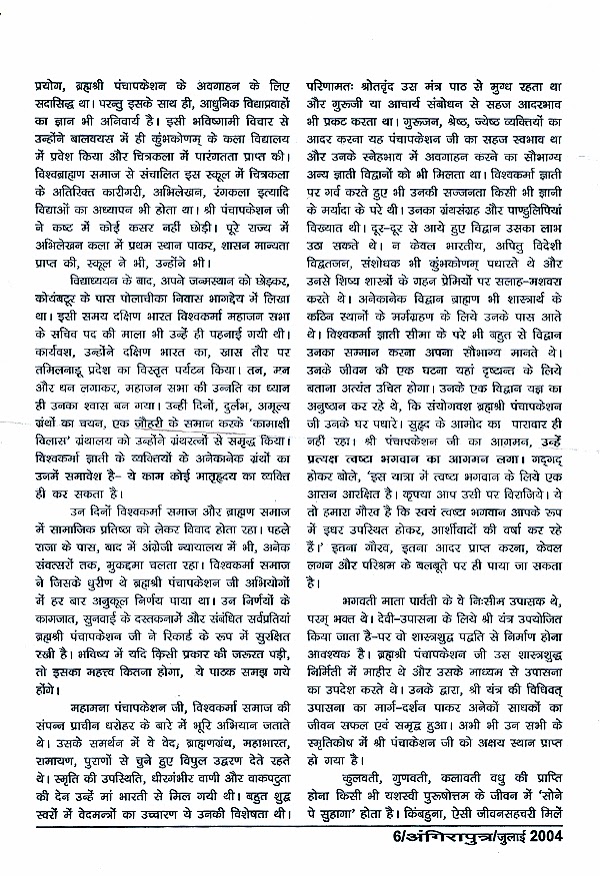
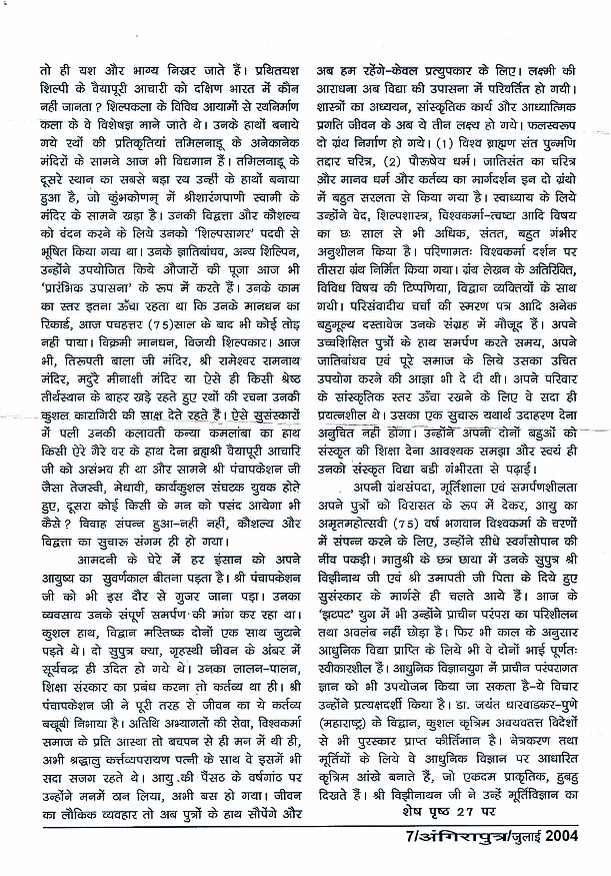
अंगिरापुत्र (Angiraputra – Hindi Magazine) - July 2004
- Vishwakarma community tradition, sculpture heritage
- Article on preservation of Vishwakarma sculptural lineage
- Detailed lineage history, temple architecture work
The Hindu – Friday Review - 5 March 2010
- Hereditary Viswakarma Architects preserving the Vedic link between knowledge, measurement, devotion, and built form.
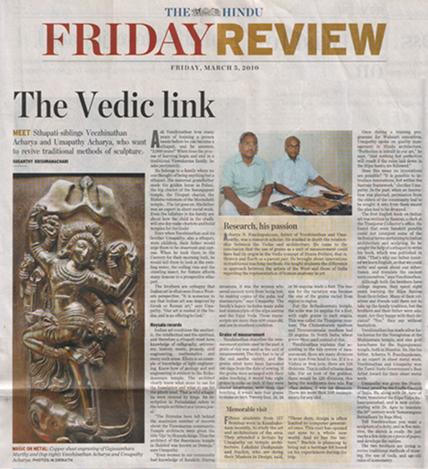
THE VEDIC LINK
Umapathy Acharya belongs to a family where no one thought of being anything but a sthapati. His maternal grandfather made the golden horse in Palani, the big chariot of the Sarangapani temple, the Tirupati chariot, the Rishaba vahanam of the Meenakshi temple… The list goes on. His father was an expert in sheet metal work. Even the lullabies in his family are about how the child in the cradle will one day make chariots and build temples for the Gods!
Research, his passion
Acharya N. Panchapakesan, father of Veezhinathan and Umapathy, was a research scholar. He studied in depth the relationship between the Vedas and architecture. He came to the conclusion that the use of grains as a unit of measurement could have had its origin in the Vedic concept of Dyava-Prithivi, that is, Heaven and Earth as a parent pair. He brought about innovations in traditional teaching methods. He taught students the difference in approach between the artists of the West and those of India regarding the representation of human anatomy in art.
Memorable visit
Fifteen students from ITT Bombay were in Kumbakonam recently, to study the art and architecture of the area. They attended a lecture by Umapathy on temple architecture. Lakshmi Deshpande and Ruchin, who are doing their Masters in Design, said, “These days, design is often limited to computer generated ones. This visit has opened our eyes to a whole new world. And so has the lecture.” Ruchin is planning to bring out a heritage kit based on his experiences during the trip.
Meet Sthapati – siblings Veezhinathan Acharya and Umapathy Acharya, who want to revive traditional methods of sculpture.
Ask Veezhinathan how many years of training a person needs before he can become a sthapati, and he answers, “2,000 years!” When does the process of learning begin and end in a traditional Viswakarma family, he asks pertinently.
Even when Veezhinathan and his brother Umapathy, also a sthapati, were children, their father would urge them to be observant and curious. When he took them to the Cauvery for their morning bath, he would tell them to look at the swirling water, the coiling vine and the crawling insect, for Nature affords many lessons to a prospective sthapati.
“The brothers are unhappy that Indian art is often seen from a Western perspective. Our art is rooted in the Vedas, and is an offering to God.”
Hoysala records
Indian art combines the aesthetic, the intellectual and the spiritual, and therefore a sthapati must have knowledge of calligraphy, astronomy, history, music, prosody, civil engineering, mathematics and many such areas. Ellora is an example of knowledge of light engineering. Know-how of geology and soil engineering is evident in the Brihadeeswara temple. The architect clearly knew what stone to use for the foundation and what to use for the plinth level. That is why sthapatis were revered by kings. An inscription in Pattadakkal refers to the temple architect as a ‘crown jewel’.
“The Hoysalas have left behind the maximum number of records about the Viswakarma community. Temple architects were given the title ‘Oja’ by Hoysala kings. Thus the architect of the Basavanna temple in Halebid was known as Demoja ,” says Umapathy.
“Even women in our community had knowledge of Sanskrit, During invasions, it was the women who saved ancient texts from beings lost, by making copies of the pal, leaf manuscripts,” says Umapathy. The family’s legacy includes many palm leaf manuscripts of the silpa sastras and the Yajur Veda. These manuscripts are more than 600 years old, and are in excellent condition.
Grains of measurement
Veezhinathan describes the measurement system used in the past. A grain of rice was used as the unit of measurement, The rice had to be of the red samba variety, and the grains must have been harvested 140 days from the date of sowing. If the grains were arranged with their sides touching, it would take eight grains to make an inch. If they were placed lengthwise, with their tips touching, it would take four grains to make an inch. Twenty four, 26, 28 or 36 angulas made a foot. The reason for the variation was because the size of the grains varied from region to region.
For the Brihadeeswara temple, the scale was 24 angulas for a foot, with eight grains in each angula. This was called the Thanjavur mozham. The Chindambaram mozham and Tiruvannamalai mozham had 25 angulas. In North India, wheat grains were used instead of rice.
Veezhinathan explains that according to the tala system of measurement, there are many divisions in an icon from head to toe. If it is a Vishnu or Shiva icon, threre are 124 divisions. This is called uthama dasa tala. For an icon of the goddess, there would be 120 divisions, this being the madhyama dasa tala. For other deities, it was 116 divisions. There are more than 200 measurements for any idol.
Once during a training programme for Walmart executives, Umapathy spoke on quality management in Hindu architecture. “Perfection is inbuilt in out art,” he says. “And nothing but perfection will result if the rules laid down in the Silpa Sastra are followed.”
Does this mean no innovations are possible? “It is possible to introduce innovations, but within the Sastraic framework,” clarifies Umapathy. In the past, when an innovation was planned, permission from the elders of the community had to be sought. A veto from them meant the plan had to be dropped.
The first English book on Indian art was written by Ramraz, a clerk at the Thanjavur Collector’s office. He found that even Sanskrit pundits could not interpret some of the technical terms pertaining to Indian architecture and sculpting, So he sough the help of a sthapati to write his book, which was published in 1826. “That’s why our father insisted we learn English, so that we could write and speak about our inheritance, and translate the ancient texts ourselves,” says Veezhinathan.
Although both the brothers have college degrees, they spent eight years learning the Silpa Sastras from their father. Many of their relatives and frients told them not to take up the family tradition, but the brothers and their father were adamant. Are they happy with their decision? “Yes,” they say without hesitation.
Veezhinathan has made silver kavachamas for the Navagrahas at the Mukteswara temple, and also gold kavachams for the Rajarajeswari temple, both in Mumbai. He, like his father, Acharya N.Panchapakesan, is an expert in sheet metal work. Veezhinathan and Umapathy won the Tamil Nadu Government’s Best Artist Award for their sheet metal work.
Umapathy was given the Sharda Prasad award by the Crafts Council of India. He, along with Dr.Apte of pune, translated the Silpa Vidya Rahasyopanishad, and is now colloaborating with Dr.Apte to translate the 10th century work “Samarangana Sutradhara’ by Raja Bhoj.
Tell Veezhinathan you want a sculpture of a deity, and in five minutes, the sketch is ready. He just marks a few dots on a piece of paper, and develop the outline.
The two brothers are trying to revive traditional methods of drawing the use of tools, and age-old rules of iconometry.
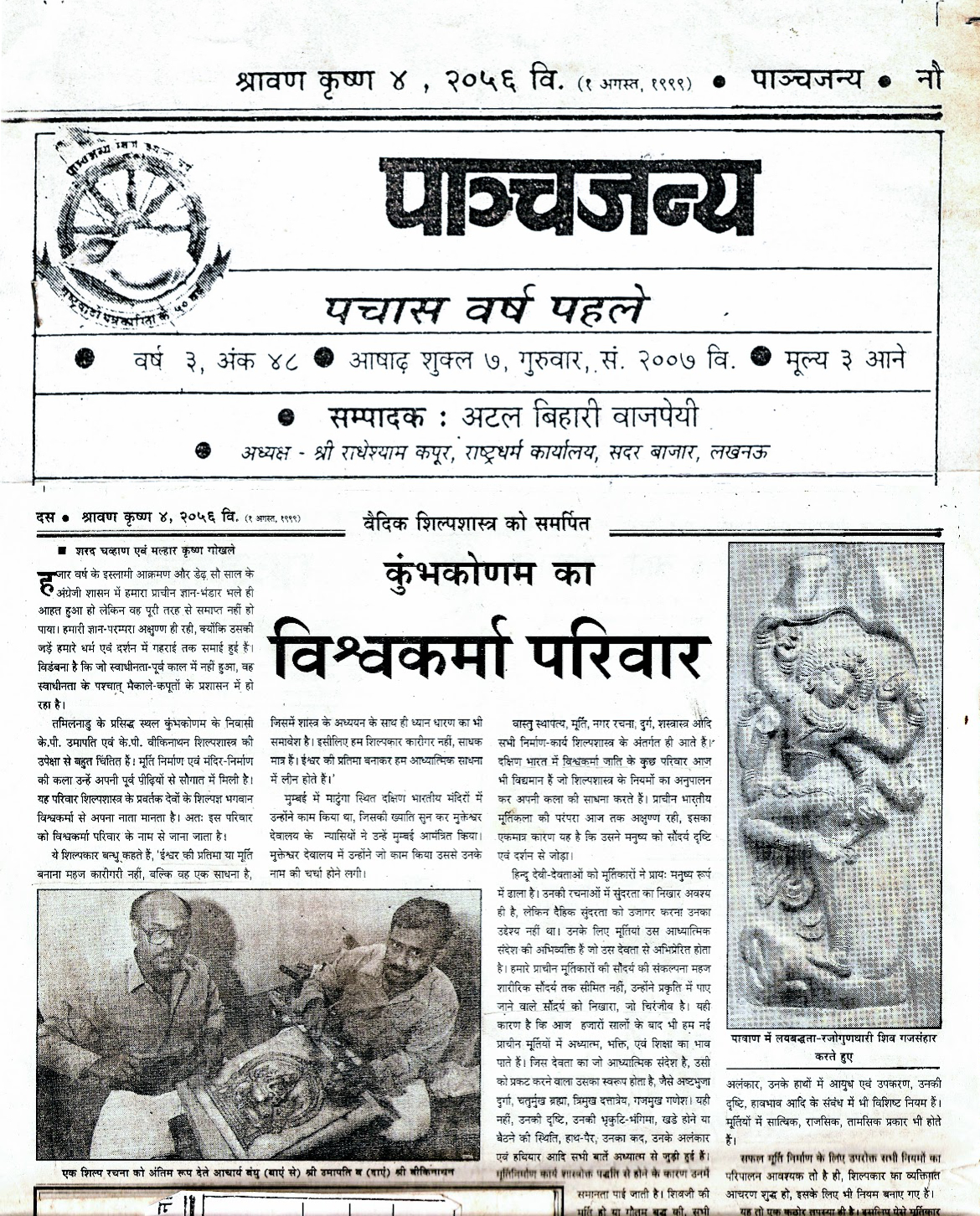
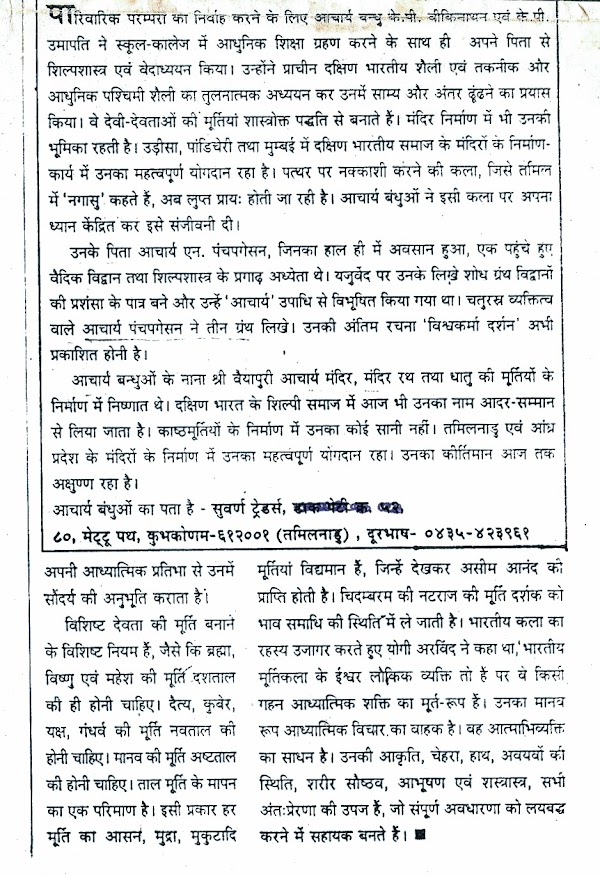
Panchjanya (magazine) - (Hindi) - 1999
Story on Kumbakonam Vishwakarma sculptor family – वैदिक शिल्पशास्त्र को समर्पित
Father–sons tradition in sculpting; ethics & training
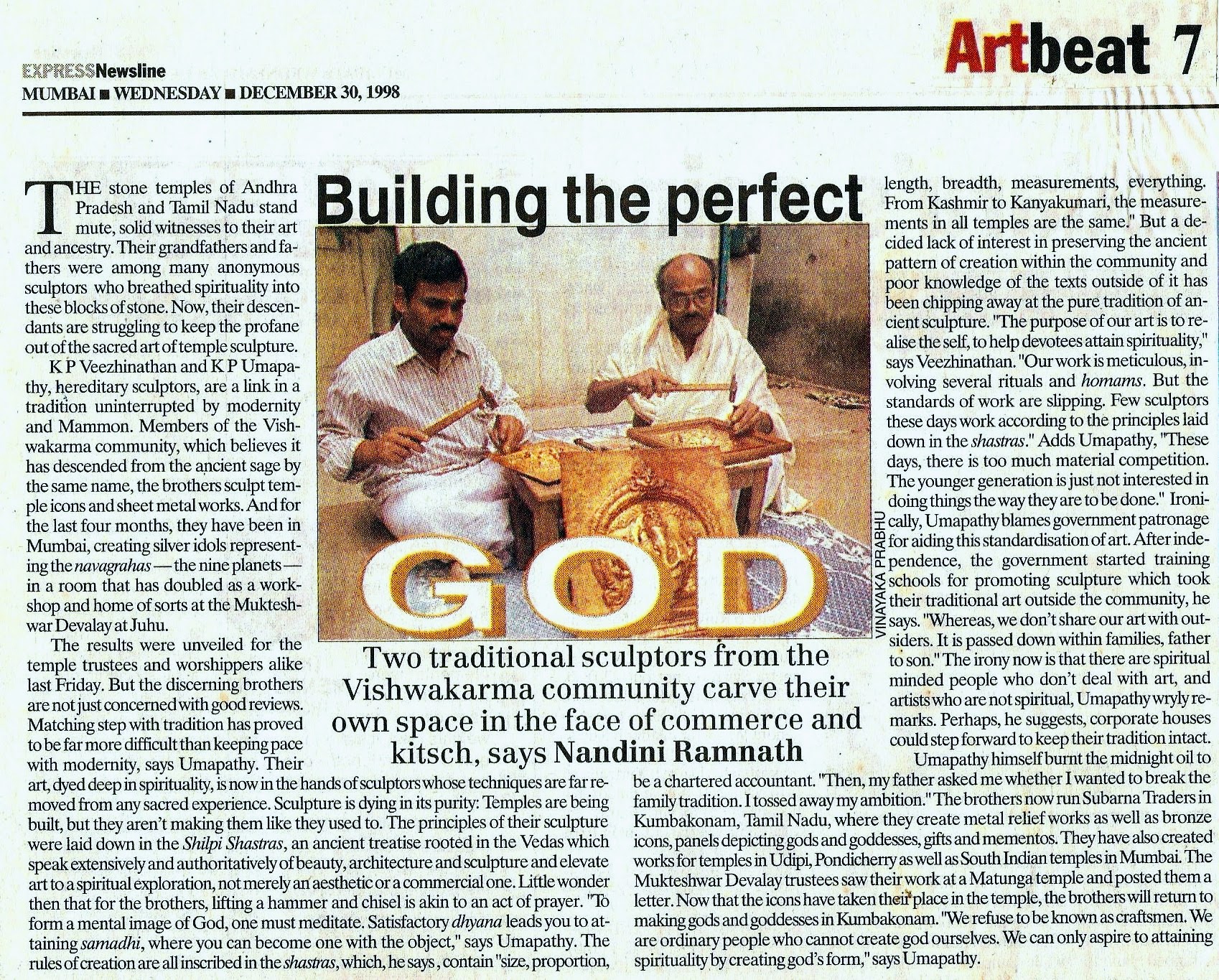
Purusharth (Hindi Magazine) - 25 September 1999
Detailed article on Kumbakonam Vishwakarma family
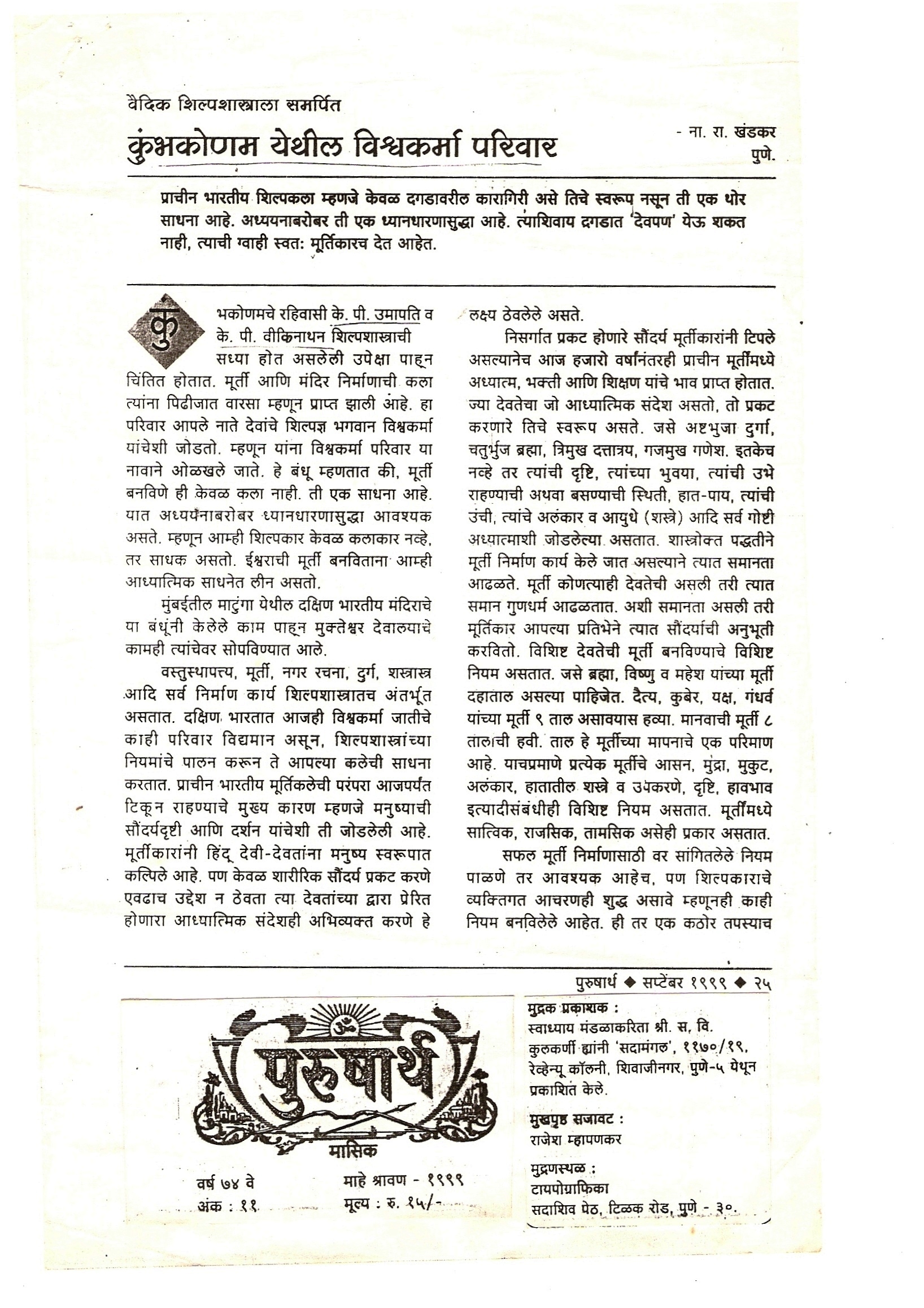
Navabharat Times (Nava Bharat Times) - 20 January 1999
- Attempt to preserve traditional sculptural methods
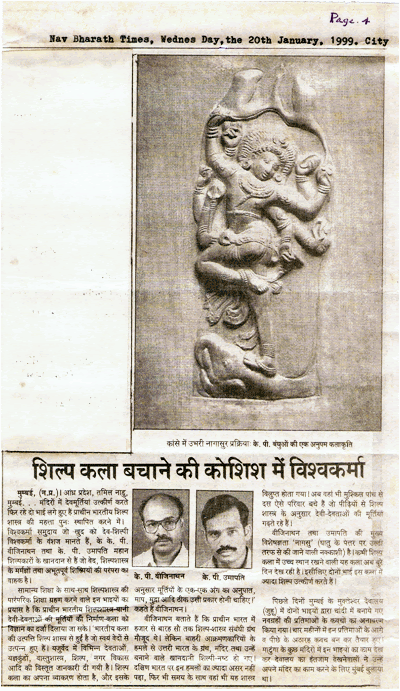
Lokasatta (Loksatta – Marathi Newspaper) - 28 December 1998
Artists preserving vanishing sculptural art
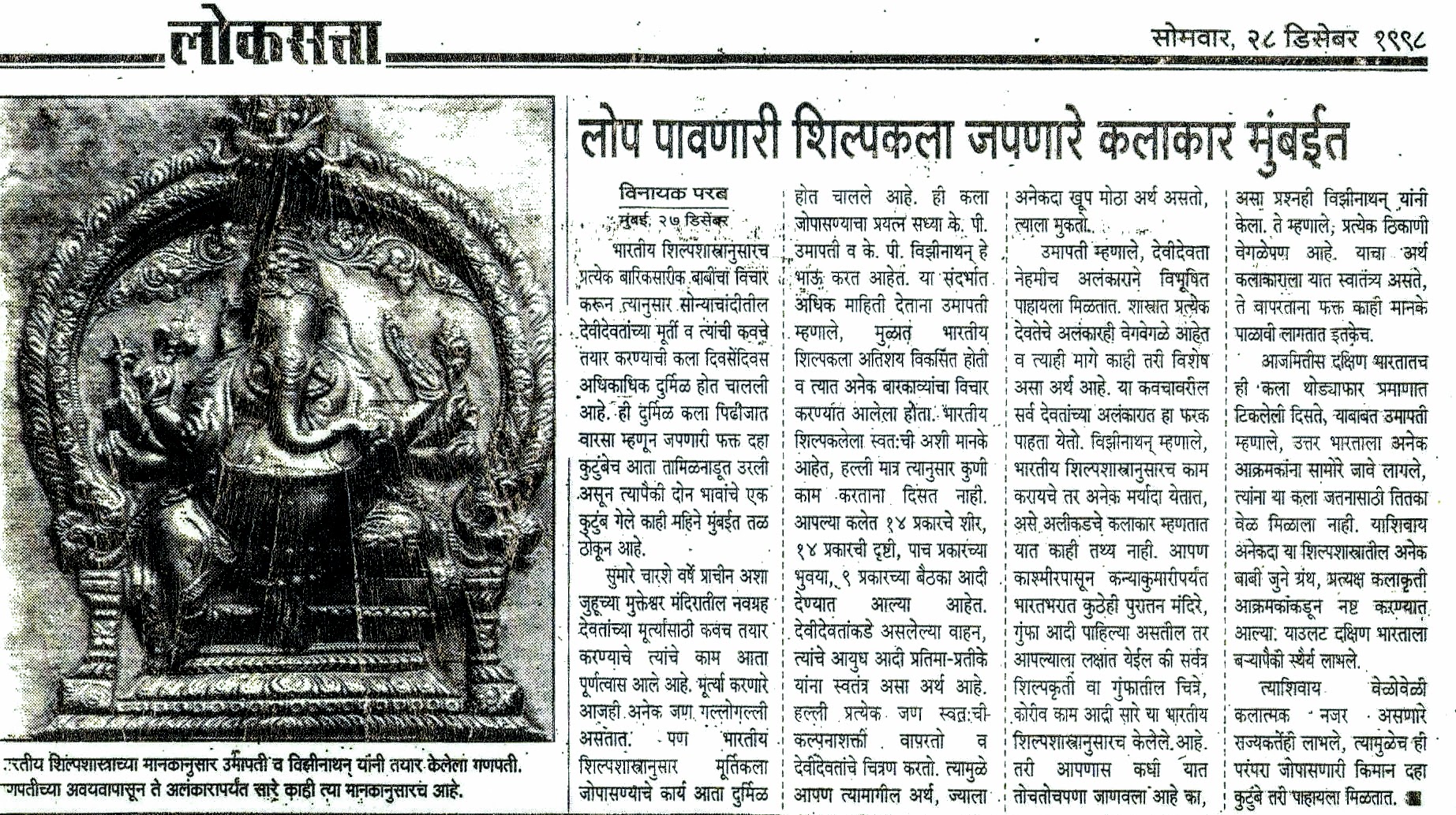
Indian Express (Artbeat) - 30 December 1998
Traditional sculptors resisting commercialization of art
Building the perfect GOD
Two traditional sculptors from the Vishwakarma community carve their own space in the face of commerce and kitsch, says Nandini Ramnath
THE stone temples of Andhra Pradesh and Tamil Nadu stand mute, solid witnesses to their art and ancestry. Their grandfathers and fathers were among many anonymous sculptors who breathed spirituality into these blocks of stone. Now, their descendants are struggling to keep the profane out of the sacred art of temple sculpture.
K P Veezhinathan and K P Umapathy, hereditary sculptors, are a link in a tradition uninterrupted by modernity and Mammon. Members of the Vishwakarma community, which believes it has descended from the ancient sage by the same name, the brothers sculpt temple icons and sheet metal works. And for the last four months, they have been in Mumbai, creating silver idols representing the navagrahas — the nine planets — in a room that has doubled as a workshop and home of sorts at the Mukteshwar Devalay at Juhu.
The results were unveiled for the temple trustees and worshippers alike last Friday. But the discerning brothers are not just impressed with grand statues. Matching steps with tradition has proved to be far more difficult than keeping pace with modernity, says Umapathy. Their art, dyed deep in spirituality, is now in the hands of sculptors whose techniques are borrowed from any strayed experience. Sculpture is rising in popularity. Temples are being built, but they aren’t making them like they used to. The principles of their sculpture were laid down in the Shilpa Shastras, an ancient treatise rooted in the Vedas which speak extensively and authoritatively of beauty, architecture and sculpture and elevate art to a spiritual exploration, not merely an aesthetic or a commercial one. Little wonder then that for the brothers, lifting a hammer and chisel is akin to an act of prayer. “To form a mental image of God, one must meditate. Besides, rhythm leads you to attaining samadhi, which you can become one with the object,” says Umapathy. The rules of creation are all laid down in the shastras, which, he says, contain “size, proportion, length, breadth, measurement, everything. From Kashmir to Kanyakumari, the measurements in all temples are the same.” But a distinct lack of interest in preserving the ancient pattern of creation within the community and poor knowledge of the craft outside of it has been chipping away at the pure tradition of ancient sculpture. “The purpose of our art is to inspire the soul, to help devotion enter spirituality,” says Veezhinathan. “Our work is meticulous, involving several rituals and penance. But the standards of work are slipping. Few sculptors these days work according to the principles laid down in the shastras.” Adds Umapathy, “These days, there is too much material competition. The younger generation is just not interested in doing things the way they are to be done.” Irony-ically, Umapathy blames government patronage for aiding this standardization of art. After independence, the government started training schools for promoting sculpture which took their traditional art outside the community, he says. “Whereas, we don’t share our art with outsiders. It is passed down within families, father to son.” The irony now is that there are spiritual-minded people who don’t deal with art, and artists who are not spiritual. Umapathy wryly remarks. Perhaps, he suggests, corporate houses could step forward to keep their tradition intact.
Umapathy himself burnt the midnight oil to be a chartered accountant. “Then, my father asked me whether I wanted to break the family tradition. I turned away from my architecture.” The brothers now run Sri Rama Traders in Kumbakonam, Tamil Nadu, where they create metal relief works as well as bronze icons, panels depicting gods and goddesses, gifts and mementos. They have created reliefs for temples in Libya, Pondicherry as well as South Indian temples in Mumbai. The Mukteshwar Devalay trustees saw their work at a Matunga temple and invited them hither. Now that the icons have taken their place in the temple, the brothers will return to making gods and goddesses in Kumbakonam. “We refuse to be known as craftsmen. We are ordinary people who cannot create gods ourselves. We can only aspire to attaining spirituality by creating God’s form,” says Umapathy.
Times of India - Chennai (TOI) - 07 December 2008
Lecture on temple sculpture, iconography of Mamallapuram
Durga images, Shilpa Śāstra teaching, heritage importance
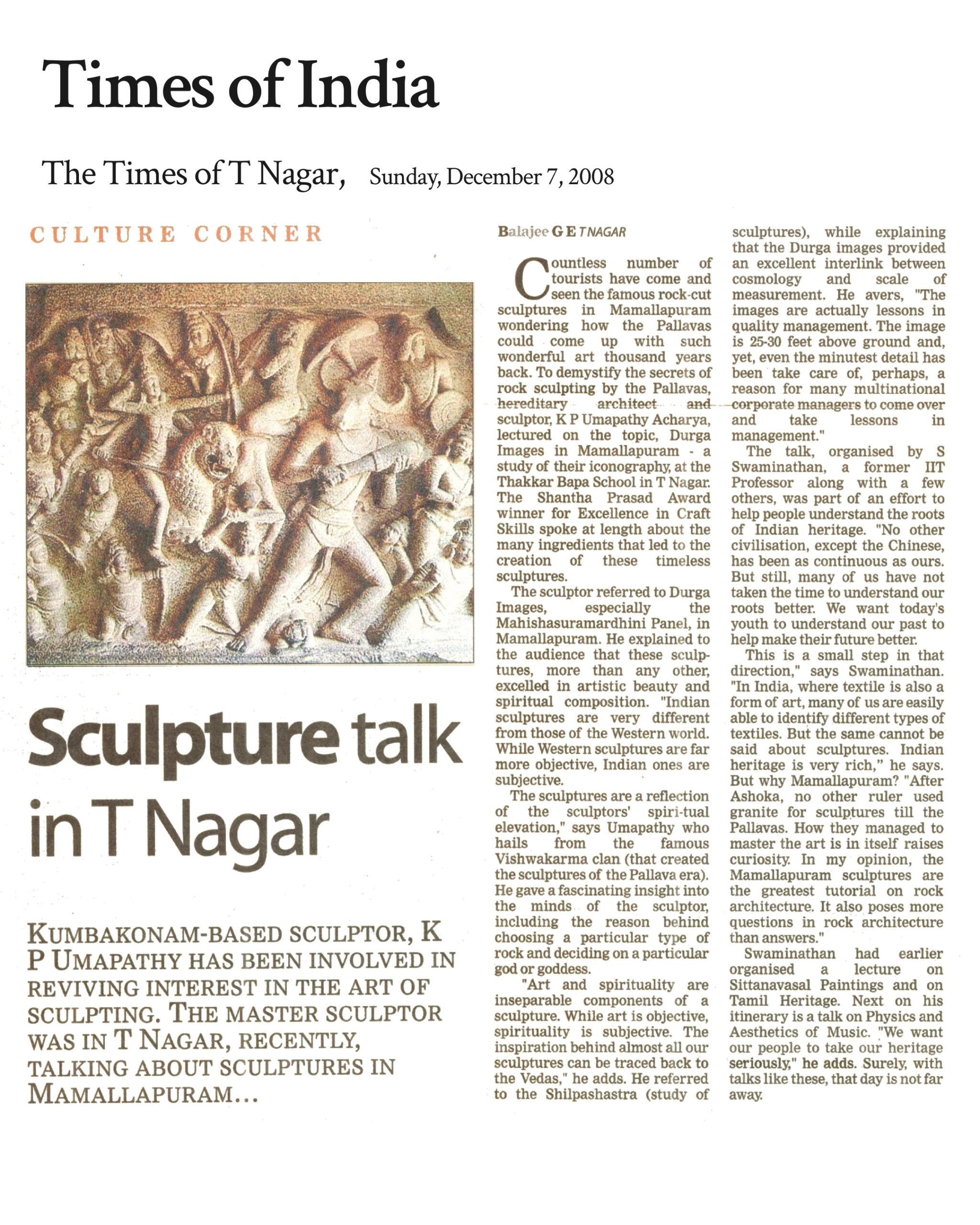
CULTURE CORNER
Sculpture talk in T Nagar
Kumbakonam-based sculptor, K P Umapathy has been involved in reviving interest in the art of sculpting. The master sculptor was in T Nagar, recently, talking about sculptures in Mamallapuram…
Balajee G E T Nagar
Countless number of tourists have come and seen the famous rock-cut sculptures in Mamallapuram wondering how the Pallavas could have come up with such wonderful art thousand years back. To demystify the secrets of rock sculpting by the Pallavas, hereditary architect and sculptor, K P Umapathy Acharya, lectured on the topic, Durga Images in Mamallapuram – a study of their iconography, at the Thakkar Bapa School in T Nagar. The Shantha Prasad Award winner for Excellence in Craft Skills spoke at length about the many ingredients that led to the creation of these timeless sculptures.
The sculptor referred to Durga Images, especially the Mahishasuramardhini Panel, in Mamallapuram. He explained to the audience that these sculptures, more than any other, excelled in artistic beauty and spiritual composition. “Indian sculptures are very different from those of the Western world. While Western sculptures are far more objective, Indian ones are subjective.”
The sculptures are a reflection of the sculptors’ spiritual elevation,” says Umapathy who hails from the famous Vishwakarma clan (that created the sculptures of the Pallava era). He gave a fascinating insight into the minds of the sculptor, including the reason behind choosing a particular type of rock and deciding on a particular god or goddess.
“Art and spirituality are inseparable components of a sculpture. While art is objective, spirituality is subjective. The inspiration behind almost all our sculptures can be traced back to the Vedas,” he adds. He referred to the Shilpashastra (study of sculptures), while explaining that the Durga images provided an excellent interlink between cosmology and scale of measurement. He avers, “The images are actually lessons in quality management. The image is 25–30 feet above ground and yet, even the minutest detail has been taken care of, perhaps, a reason for many multinational corporate managers to come over and take lessons in management.”
The talk, organised by S Swaminathan, a former IIT Professor along with a few others, was part of an effort to help people understand the roots of Indian heritage. “No other civilisation, except the Chinese, has been as continuous as ours. But still, many of us have not taken the time to understand our roots better. We want today’s youth to understand our past to help make their future better.
This is a small step in that direction,” says Swaminathan. “In India, where textile is also a form of art, many of us are easily able to identify different types of textiles. But the same cannot be said about sculptures. Indian heritage is very rich,” he says. But why Mamallapuram? “After Ashoka, no other ruler used granite for sculptures till the Pallavas. How they managed to master the art in itself raises curiosity. In my opinion, the Mamallapuram sculptures are the greatest tutorial on rock architecture. It also poses more questions in rock architecture than answers.”
Swaminathan had earlier organised a lecture on Sittanavasal Paintings and on Tamil Heritage. Next on his itinerary is a talk on Physics and Aesthetics of Music. “We want our people to take our heritage seriously,” he adds. Surely, with talks like these, that day is not far away.
The Asian Age - 4 December 1998
- Traditional approach to sculpture; Vedic roots of Indian art
THE PAST IS THE PRESENT, ARGUES TRADITIONAL ARTIST BY JASMINE SHAH
“THE Europeans considered Indian art as barbaric and not fine art,” laments K.P. Umapathy, a Kumbakonom-based traditional temple sculptor, who is in Mumbai with his brother for some temple work.
Having studied the ancient traditional art of India as told in the Shilpa Shastras, the brothers make sculptures of gods, goddesses and of other religious themes.
But Umapathy is a little uneasy though rather amused at the way their art is perceived. “After Independence, the government gave traditional sculpture the status of craft,” he says with heart-felt regret. “It falls under the ministry of textiles at the moment,” he adds, laughing.
Umapathy and Veezhinathan come from a family of Vedic scholars and great sculptors. While studying at formal educational institutions, they learned the Vedas and Shilpa Shastras from their father, Acharya Panchapagesan. The brothers specialise in metal relief work.
Temple art, in the form of the beautiful stone carvings which decorate the entire temple from the interiors to the exteriors in minute detail and with great precision of skill, is not looked on as a living form of art in our age. However, in the south there are a few families of the Viswakarma community who practice the traditional art following the Shilpa Shastras. Of course there is some deviation and there are very few who strictly follow it.
The argument that arises here is the age-old one about how to classify art and craft. To the layman of our generation, traditional art seems stagnant, repetitive and certainly not innovative or creative. One would think that every sculpture of lord Shiva in every temple looks almost the same, for instance; unlike in contemporary art where every artist makes it a point to be as individualistic as possible.
However Umapathy explains the whole concept of Indian art, be it dance, music, fine arts or architecture. “Indian art springs from Shilpa Shastra which originated from the Vedas,” he says. “The Yajur Veda, to be precise, speaks extensively about the different gods, yagna kundas, architecture, sculpture, town planning, vastu shastra, fort building and weapons as well.”
AGE-OLD DEBATE
The point that Umapathy wants to make is simple. “Indian art has a long history. It has a grammar and it is intermingled with religion, philosophy, yoga, tantric, it has elements of divinity. How can it be equated with the making of bamboo baskets (a craft)?” he asks, sorrow in his voice.
Umapathy agrees that there is a rigid grammar which has to be followed. For instance, the measurements, the proportions, the hastas (hand gestures) and the posture, among other elements, have to be followed in exactly the way that they are mentioned in the Shastras.
If the goddess Durga has eight hands and Lord Brahma has four heads, it has to be so. But the difference is that a good sculptor does not make these mechanically; meditation forms an integral part of his activity and that makes his creations unique.
Explaining this, Umapathy says, “Dhayana slokas in the Shilpa Shastras speak extensively of definite and prescribed proportions of images of icons. The measurements and ratios of the icons are highly technical and complicated. However the objective of the sculptor in representing gods is not to imitate the excellence or beauty of human forms but to give expressions to a spiritual message that the forms of gods were intended to impart.
“Even if there are specifications to follow and there is a uniformity of subject, a sculptor brings out his creativity marking his personality and genius in his work within those restrictions.”
While Indian art has always been connected to religion and philosophy, contemporary art has not primarily focused its attention on bhakti or prayers to gods. This is the major difference that draws the line between the two forms, as the ideologies behind them vary.
That, of course, does not mean that contemporary artists do not follow religion or give no place to it in art. Even among these artists there are those who are inspired by religious subjects, but the manifestation is different as the methodology and approach is different.
Similarly, considering the traditional form as craft also seems inappropriate, for connoisseurs can read the difference in the styles of one creator and another. The bhava with which the sculpture is made, even if it is the same in terms of posture and other such aspects, affects the way the final piece looks.
What Umapathy wonders is why art galleries discard the work of traditional artists, saying that they exhibit only contemporary art. Asks Umapathy, “Am I living for 500 years that the art I create is not considered contemporary?”
Whatever the answer is to Umapathy’s query, the point made is that temple art has a lot more to it than the little importance it is given. And perhaps, now that we are by and large going back to our roots, it will be seen as a living art form again.
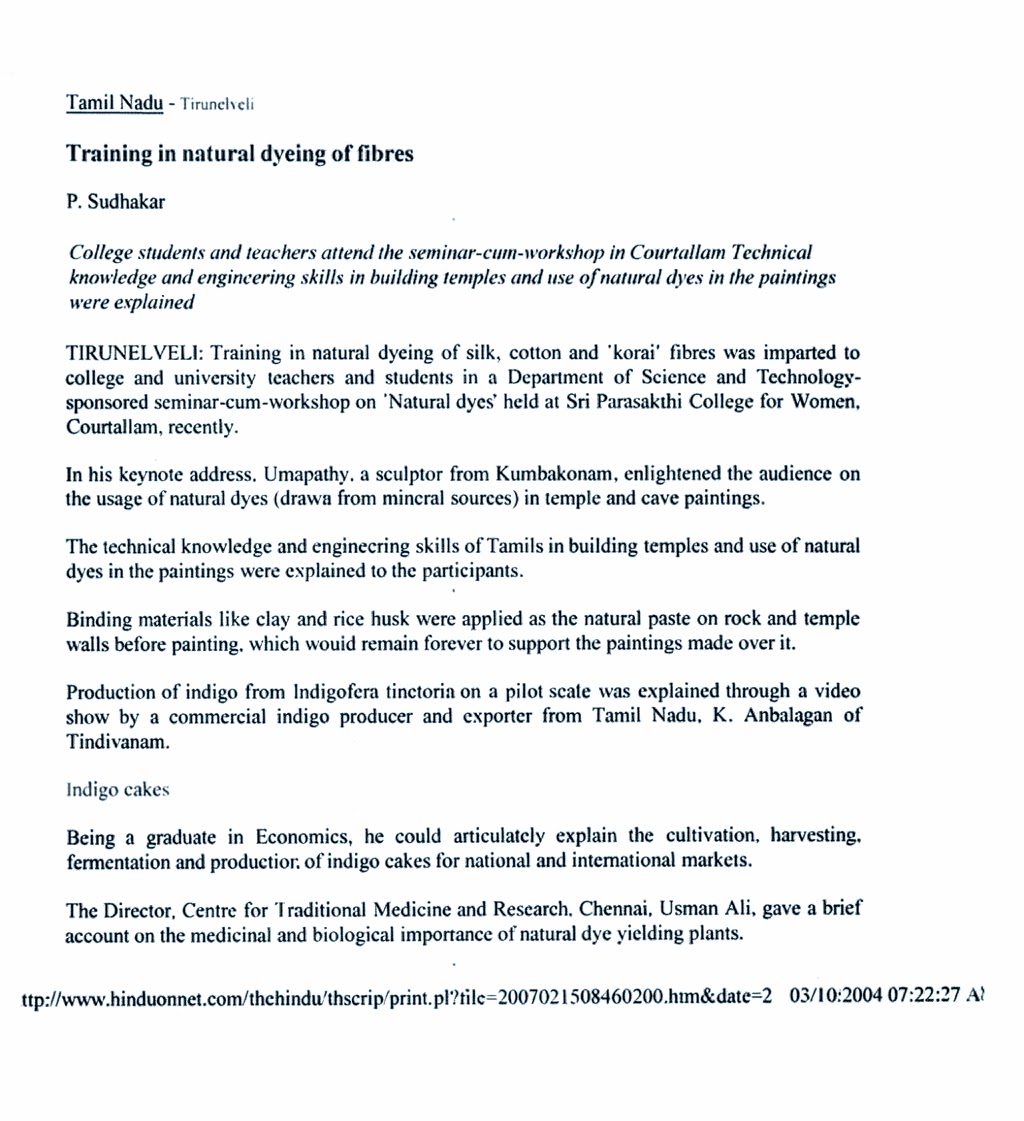
The Hindu (Tamil Nadu Section) - Oct 2004
Seminar on temple painting, natural dyes, engineering knowledge